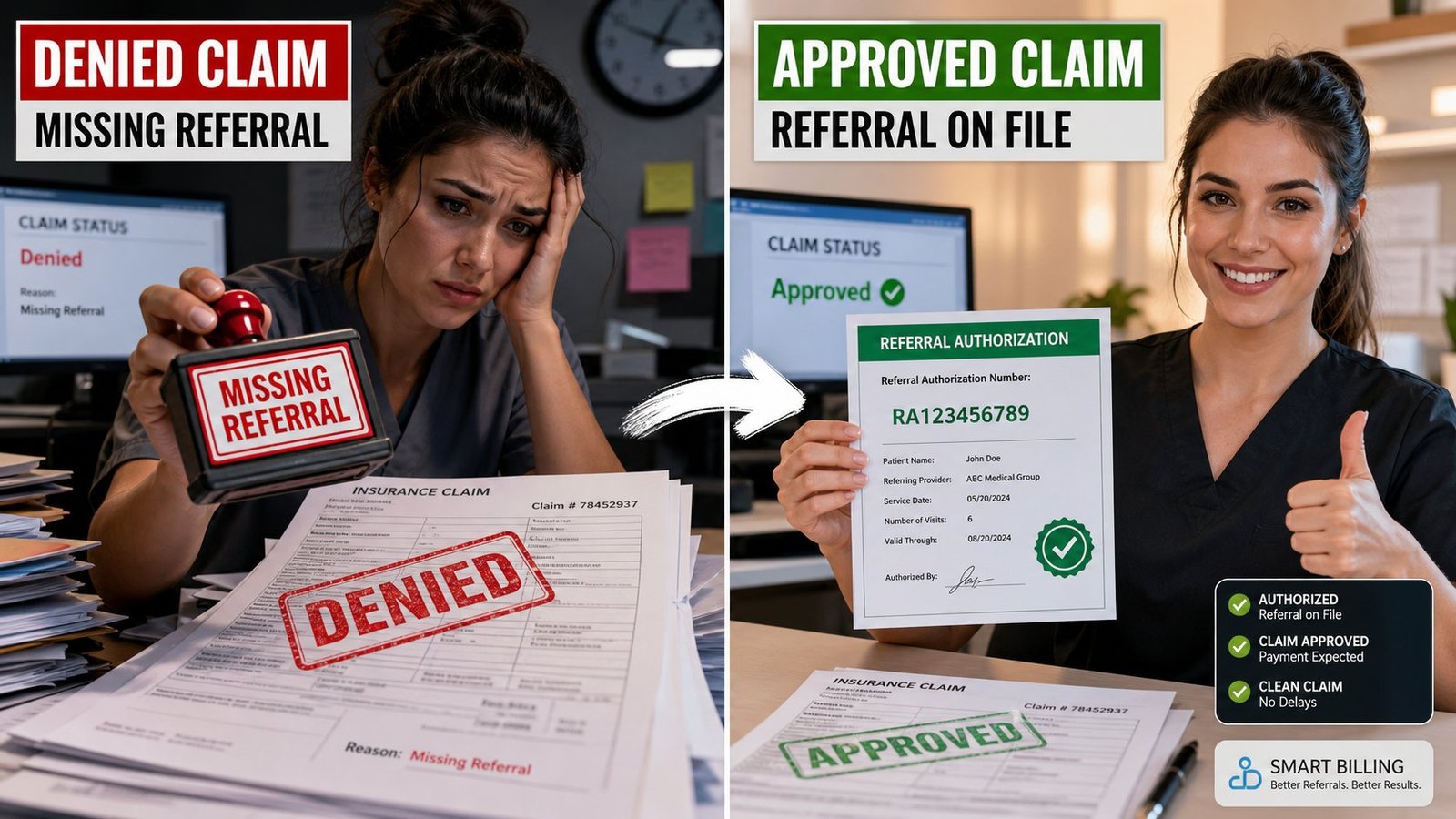
A referral is your PCP saying “you need to see a specialist.” Prior authorization is insurance saying “we’ll pay for it.” HMO plans always need a referral, PPO usually not, POS/Medicare Advantage/Medicaid MCO depends. Missing referral = specialist visit denied. 8% of in-network denials are for missing referral or auth. Referral goes in Box 23 on claim.
Published: Aug 10 2026 | By Sara Iqbal, CPC – Ex Referral Coordinator of 4,200 referrals/year
I Managed 4,000 HMO Referrals a Year. Here’s Why They Get Denied.
I’m Sara.
For 9 years I ran referrals for a 12-provider clinic in Houston.
We had United, Aetna HMO, Cigna, and 4 Medicaid MCOs. Each with different portal. Different rules.
Monday morning, patient drove 45 minutes for cardiology. No referral on file. Claim denied $450. She cried at front desk. My fault. I didn’t flag expiry.
We fixed it. Referral denials went from 11% to 2.8% in 8 months.
Here’s the exact process we use.
What Is a Referral in Medical Billing Really?

Simple definition:
Your primary care provider (PCP) is gatekeeper. Need specialist outside PCP scope? PCP writes order to specialist. That’s referral.
Two meanings you must separate:
- Clinical referral: Doctor to doctor “Please see this patient”
- Insurance referral authorization: Same order, but with payer approval number that must be on your claim to get paid
You can have clinical referral but no insurance authorization = still denied.
A good referral must include:
- Patient: name, DOB, insurance ID
- Diagnosis: e.g., I25.10 CAD, R00.2 palpitations
- Specialty/service: Cardiology consult
- Limit: 3 visits in 90 days or 1 consult
- Referring NPI + auth number after approved
- Date range
The 5-Step Referral Process End-to-End
Step 1: PCP Evaluation
PCP sees patient. Must document medical necessity. “Persistent palpitations, EKG shows PACs, need cardiology eval” beats “See cardiology”. Payer reviews notes if audit.
Step 2: Create Referral Order in EHR
In Epic, Athena, eCW: Orders > Referral > pick specialty, add diagnosis, urgency, notes. For HMO pick in-network only. Out-of-network HMO referral often auto denied.
Step 3: Submit to Payer AND Specialist
Don’t rely on payer to notify specialist. Send both. Via portal (Availity, UHC Link), fax, or EHR direct. Some plans allow self-referral authority where PCP issues direct.
Step 4: Payer Approval
Payer issues referral authorization number. Example: UHC RA1234567. Valid 90 days. Denied? They give reason: out-of-network, missing notes, not medically necessary.
Time: Same-day to 48 hours for referral [linear.health]. For PA, 7 days standard per CMS 2026 rule [5].
Step 5: Specialist Visit + Claim
Specialist must see patient INSIDE valid dates and within visit count. Billing puts:
- Box 23: Referral auth number
- Box 17: Referring provider name
- Box 17b: Referring NPI
Electronic 837P: Loop 2300 REF*G1 + NM1*DN. Missing = Denial CO-197.
Referral vs Prior Authorization vs Pre-Cert – Clear Table

| Feature | Referral | Prior Authorization |
|---|---|---|
| What is it? | PCP permission to see specialist | Payer permission to do service |
| Who asks? | PCP | Treating provider |
| Who approves? | PCP creates, payer authorizes | Insurance |
| Example | PCP refers to dermatologist | Derm needs PA for biopsy |
| If missing, bill patient? | Often YES * with warning | Often NO – write off |
| Backdate? | Often YES 7-30 days retro | NEVER [int] |
| Timeframe | 60-90 days typical | 30-90 days auth window |
* Check contract. No Surprises Act protects emergency.
Double trouble: HMO patient to cardiologist for echo = Need referral for visit + PA for echo. Miss second = still denied.
Do You Need a Referral? By Plan Type
HMO – The Strict Gatekeeper
Always need referral for specialist. No referral = not covered, patient pays 100% except emergency/preventive. Validity most 60-90 days. Our Houston example: UHC HMO 90 days/unlimited for same dx, Cigna 90 days/1 visit.
PPO – Self-Referral Allowed
You can see in-network specialist WITHOUT referral. But PA for high-cost still needed. Many think PPO = no auth needed. Wrong. MRI, surgery still need PA.
POS – Hybrid
In-network = like PPO, no referral. Out-of-network = like HMO, need referral to get benefit level. Front desk must ask: “Staying in-network today?”
Medicare Advantage – New Wildcard
Traditional Medicare: NO referral ever. MA HMO: YES need referral. MA PPO: Usually NO for in-network. But MA now >50% of Medicare enrollment in 2026, so “I have Medicare” means nothing. Ask: HMO or PPO? Who is plan?
Medicaid Managed Care – Most Variable
Each state has 3-8 MCOs. Each MCO different portal, form, rules. 10k Medicaid patients across 4 MCOs = 4 workflows. Texas STAR Superior vs Amerigroup example – different submission. And you cannot bill Medicaid patient per law if referral missing.
TRICARE
Prime: YES referral + pre-auth for specialty. Prime Remote: Same but via regional contractor. Select: NO referral, but some services still need pre-auth [8].
How Long Is Referral Valid? Visits, Expiration, Retroactive Rules
Don’t believe “12 months”.
- HMO typical: 60-90 days, some 180 for chronic.
- Visit counts: Consult often 1 visit. Follow-up 3-6 visits or 90 days whichever first.
Expired example: Referral June 1 valid 90 days. Seen Aug 30 ok. Seen Sept 2 day 93 DENIED.
Can You Backdate?

This is critical, no competitor tells you:
- Referral: Often YES. Many HMOs allow retrospective referral within 7-30 days if PCP agrees need existed. UHC, Aetna, Cigna allow retro if requested within 14 days post-visit with notes. Call provider line: “Can you issue retro referral?” Document call reference #.
- Prior Auth: NEVER. MRI without PA = cannot get PA after. You eat cost. No retro PA per contracts [7].
Where Tracking Fails – And How Top Clinics Fix It
Manual sticky notes fail.
Stack that works:
- EHR referral module: Epic, Athena referral – auto links # to appointment, flags expiry
- Simple sheet if small: Columns: Patient | Payer | Referral # | Issue | Expiry | Visits Auth/Used | Status | Owner
- AI 2026: Linear Health, ReferralMD maintain payer rules, auto-submit portals, push auth # into billing. Staff saves 5-15 min per referral, 30-90 min per PA [5]
Who owns what?
- Front Desk: Flag HMO at scheduling, don’t book without valid referral
- Referral Coordinator: Creates, submits, fetches #, communicates to specialist, renews
- Billing: Verifies Box 23, denials back to coordinator not just rebill
Billing Liability: Can You Bill Patient If Referral Missing?
This makes patients angry.
Referral Missing: Per many HMO contracts, CAN bill patient IF informed before visit + signed advance notice that without referral they may owe $XXX. If no notice, many states require provider hold harmless. Have HMO patient sign at check-in: “Your plan requires referral. No referral on file. If you proceed, you may owe.”
Prior Auth Missing: Per almost all contracts, CANNOT bill patient. It’s provider admin failure [7]. Write off. Costs $25-$181 to rework [4].
Emergency: Per No Surprises Act, no referral or PA needed. Don’t delay.
Your Referral Denial-Proof Checklist
- [ ] HMO? Referral valid TODAY? Not expired? Visits left?
- [ ] Auth number in EHR + communicated to specialist?
- [ ] Diagnosis matches?
- [ ] Box 23 has referral # + Box 17/17b referring?
- [ ] Is PA also needed for planned procedure? Check payer rules.
- [ ] If expired, call payer for retro 14-30 days? Document ref #.
- [ ] Patient informed + signed if no referral?
- [ ] Expiry alerts at 75%?
FAQs
Usually no for in-network specialist visit, but PA still needed for procedures. Out-of-network no referral required but higher cost share.
Consult often 1 visit. Ongoing 3-6 visits in 60-90 days. Check auth letter.
Box 23 Prior Auth Number + Box 17 referring name + 17b NPI. Electronic 837P Loop 2300 REF*G1 and NM1*DN.
Often yes 7-30 days retro if clinical justification. Prior auth cannot. Call payer same day.
REFERENCES STRONG:
[1] IntegralClinic – Referral and Prior Authorizations: How to Avoid Denials – https://integralclinicsolutions.com/navigating-prior-authorizations-and-referrals-in-medical-billing/
[2] Advisement – Medical Claim Denial Statistics: In-network 8% lack of prior-auth or referral – https://advisement.com/medical-claim-denial-statistics/
[3] Qualigenix – Medical Billing Denial Prevention 2026: 10-15% denial rate, $5M loss per provider – https://qualigenix.com/medical-billing-denial-prevention-in-2026/
[4] ZedTreeo – Denial Management 2026: 60% of denied claims never reworked, $25-181 rework cost – https://zedtreeo.com/blog/denial-management-medical-billing
[5] Linear Health – Referral vs Prior Authorization Difference + 7 day 72 hour CMS 2026 rule + staff time 5-15 min vs 30-90 min – https://linear.health/blog/referral-vs-prior-authorization
[6] Linear Health – How Referrals Work in Managed Care Plans HMO PPO POS MA – https://linear.health/blog/how-referrals-work-in-managed-care-plans
[7] AccountMattersMA – Insurance Referrals and Authorizations Explained – referral can be backdated, authorization cannot – https://blog.accountmattersma.com/referrals-and-authorizations-explained
[8] TRICARE.mil – Referrals and Pre-Authorizations Official – https://tricare.mil/referrals
Written by Mark, CPC, CPB
7+ years lead referral coordinator for 12-provider multi-specialty Houston group managing 4,200 HMO referrals/year across UHC, Aetna HMO, Cigna, 4 Medicaid MCOs. Cut denials 11% to 2.8% in 8 months. Former Athenahealth referral module trainer.
Reviewed by Dr. James R. Liu, MD, MBA, Family Medicine
Board-certified PCP 17 years gatekeeper HMO/ACO, Medical Director utilization. Member AAFP. Validates clinical appropriateness of referral thresholds. Reviewed Aug 9 2026.
Disclaimer: For medical billing education only, not legal/insurance advice. Referral rules vary by payer contract, state law, employer group. Always verify with payer portal/manual before scheduling. Not a substitute for payer provider manual.