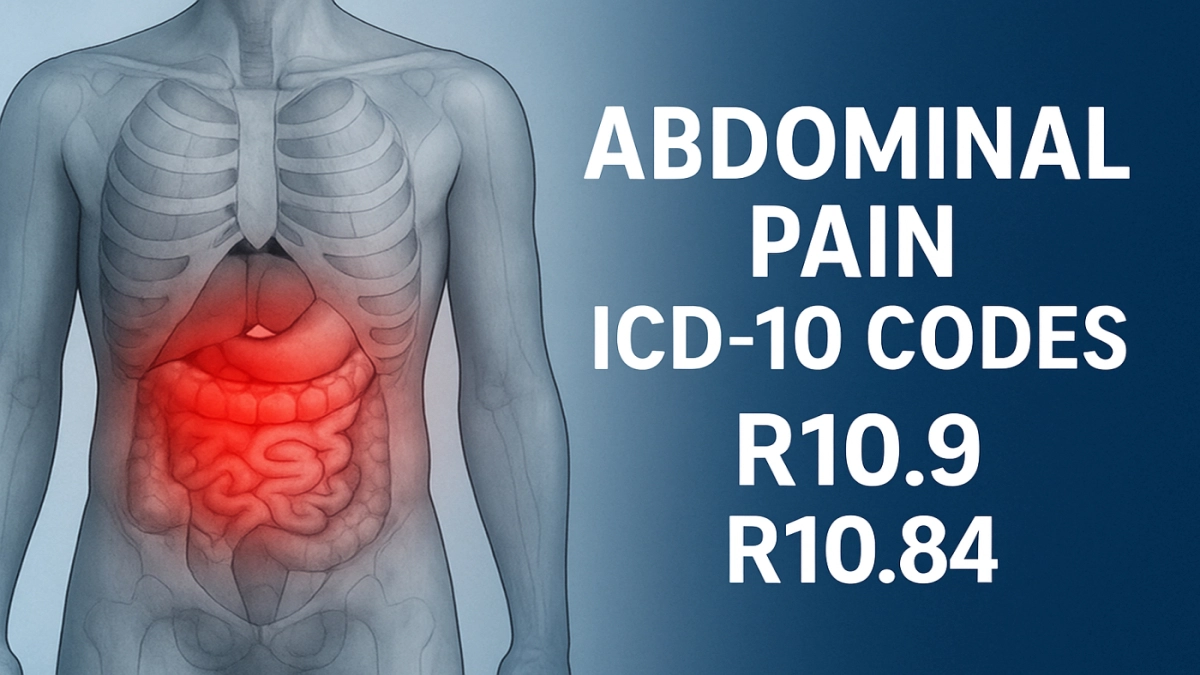
The ICD-10-CM code for unspecified abdominal pain is R10.9.
It is billable. It is valid for FY 2026. And it should be your last pick, not your first.
If the note names a location (right lower quadrant, epigastric, flank, and so on), use that more specific R10 code. If a confirmed disease explains the pain appendicitis, diverticulitis, gastritis code the disease, not the symptom.
R10.9 vs R10.84 in one line:
R10.9 = location never stated.
R10.84 = pain is clearly generalized across the abdomen.
Those are not the same code.
For busy coders: Read the whole note. Match location if it exists. Save R10.9 for true unknowns. Upgrade the code when the workup graduates to a disease.

What R10.9 actually means
R10.9 sits in Chapter 18 of ICD-10-CM: Symptoms, signs and abnormal clinical and laboratory findings, not elsewhere classified (R00–R99). Inside that chapter, the R10 category covers abdominal and pelvic pain.
According to the 2026 tabular listing, R10.9 is a billable/specific code. The FY 2026 edition took effect on October 1, 2025. For inpatient grouping, R10.9 maps to MS-DRG 391 (with MCC) and 392 (without MCC) under digestive disorder groupings when it drives the principal diagnosis logic for that DRG family.
In plain English: R10.9 means the patient has abdominal pain, and the record does not give you a usable location, pattern, or confirmed cause at the time you code the encounter.
That can be honest medicine. First visits are messy. Pain moves. Patients cannot always point to a spot. Tests are pending. CMS knows this. The Official Guidelines say sign and symptom codes are acceptable when a related definitive diagnosis has not been established.
What CMS does not bless is laziness. If the HPI says “right lower quadrant” and the exam shows RLQ tenderness, R10.9 is the wrong code—even if the Assessment line only says “abdominal pain.”
The complete R10 series for FY 2026
R10 itself is not billable. You must drop to a child code. Below is the working set most U.S. outpatient, urgent care, ED, and facility coders need on one screen.
Core location and severity codes
| ICD-10-CM | Description | When it fits |
|---|---|---|
| R10.0 | Acute abdomen | Sudden, severe pain with peritoneal worry—surgical urgency language in the note |
| R10.10 | Upper abdominal pain, unspecified | Upper abdomen only; side not named |
| R10.11 | Right upper quadrant pain | RUQ documented |
| R10.12 | Left upper quadrant pain | LUQ documented |
| R10.13 | Epigastric pain | Epigastrium / upper middle |
| R10.2- | Pelvic and perineal pain | See laterality expansion below |
| R10.30 | Lower abdominal pain, unspecified | Lower abdomen; quadrant not named |
| R10.31 | Right lower quadrant pain | RLQ documented |
| R10.32 | Left lower quadrant pain | LLQ documented |
| R10.33 | Periumbilical pain | Around the umbilicus |
| R10.84 | Generalized abdominal pain | Diffuse / whole-abdomen pain is described |
| R10.9 | Unspecified abdominal pain | No location or useful pattern in the record |
Tenderness, rebound, colic, and multi-site (R10.8x)
| ICD-10-CM | Description |
|---|---|
| R10.811 – R10.817 / R10.819 | Abdominal tenderness by site (incl. generalized / unspecified) |
| R10.821 – R10.827 / R10.829 | Rebound abdominal tenderness by site |
| R10.83 | Colic |
| R10.84 | Generalized abdominal pain |
| R10.85 | Abdominal pain of multiple sites (FY 2026) |
| R10.8A1 | Right flank tenderness (FY 2026 family) |
| R10.8A2 | Left flank tenderness |
| R10.8A3 | Suprapubic tenderness |
| R10.8A9 | Flank tenderness, unspecified |
R10.85 caution: Multi-site pain is not a shortcut for “I saw two words in the note.” Check current Excludes1 notes in the tabular before pairing R10.85 with generalized pain, acute abdomen, rigidity, or other restricted combinations.
Flank pain — dedicated codes (FY 2026)
Before October 1, 2025, flank pain often got forced into R10.9 or a nearby “other” code. That gap is closed.
| ICD-10-CM | Description |
|---|---|
| R10.A0 | Flank pain, unspecified side |
| R10.A1 | Flank pain, right side |
| R10.A2 | Flank pain, left side |
| R10.A3 | Flank pain, bilateral |
Pelvic / perineal laterality (expanded)
| ICD-10-CM | Description |
|---|---|
| R10.20 | Pelvic and perineal pain, unspecified side |
| R10.21 | Pelvic and perineal pain, right side |
| R10.22 | Pelvic and perineal pain, left side |
| R10.23 | Pelvic and perineal pain, bilateral |
| R10.24 | Suprapubic pain |
Always confirm the exact child code in your encoder or the current CDC/NCHS tabular before final bill drop. Local EHR pick-lists lag the code set more often than people admit.

R10.9 vs the codes people mix up
R10.9 vs R10.84 (the #1 mix-up)
I still see this weekly when I review denial queues.
- Provider writes: “diffuse abdominal pain,” “pain throughout the abdomen,” “generalized tenderness.”
→ R10.84 - Provider writes only: “abdominal pain,” “abd pain,” “stomach pain,” with no location and no “generalized” language.
→ R10.9
R10.84 means you know the distribution. R10.9 means you don’t. Payers treat them differently because one shows clinical characterization and the other looks like a documentation shortcut.
R10.9 vs R10.0 (acute abdomen)
R10.0 is not “pain that started today.”
Acute abdomen points to a severe, acute presentation—guarding, rigidity, surgical abdomen language, emergency workup. If the chart supports that picture, R10.0 is stronger and more precise than R10.9.
R10.9 vs quadrant codes (R10.11, R10.31, etc.)
If any part of the note localizes the pain—chief complaint, HPI, ROS, or exam—use the location code. Coders who only read the Assessment line create avoidable denials.
R10.9 vs flank (R10.A-)
Flank pain is no longer a free pass to unspecified. Use R10.A1–R10.A3 when laterality is known. Use R10.A0 only when the side truly is not documented.
R10.9 vs a definitive diagnosis
Once appendicitis, cholecystitis, pancreatitis, colitis, UTI, or another confirmed condition is established as the reason for the encounter, code that condition. Do not keep stacking R10.9 visit after visit out of habit.
Excludes notes you cannot ignore
Under R10 Abdominal and pelvic pain:
- Excludes1: renal colic (N23).
Excludes1 means “not coded here.” Do not pair R10.9 (or other R10 pain codes) with N23 on the same claim when the pain is renal colic. Code N23. - Excludes2 examples at category level include costovertebral angle tenderness (more fully captured under R39.85- in FY 2026), dorsalgia (M54.-), and flatulence-related codes (R14.-). Excludes2 means the conditions are not part of R10, but a patient can have both; follow tabular guidance when both are relevant.
Also remember: generalized pain NOS and pain NOS live under R52, but localized abdominal pain is directed to R10.- — so don’t park belly pain on R52.
When CMS says symptom codes (like R10.x) are allowed
The FY 2026 ICD-10-CM Official Guidelines for Coding and Reporting are clear on two points that feel like they fight each other—until you code real charts.
- Signs and symptoms are acceptable when a related definitive diagnosis has not been confirmed by the provider.
- Code to the level of certainty known for that encounter. Unspecified codes have “acceptable, even necessary, uses,” but specific codes should be reported when the record supports them.
Chapter 18 notes also describe classic use cases for symptom coding: workup incomplete, findings transient, patient left before diagnosis, referral out before confirmation, or no more precise diagnosis available after investigation.
Practical rule I teach new coders:
- Is there a confirmed cause? → Code the cause.
- If not, is location or pattern documented? → Code the matching R10 child.
- Only if neither applies → R10.9.
- At the next visit, upgrade the code if the picture is clearer.
Why abdominal pain coding gets so much payer attention
Abdominal pain is not a rare complaint. It is one of the most common reasons adults come to U.S. emergency departments. CDC NHAMCS materials have repeatedly placed stomach and abdominal pain near the top of principal reasons for ED visits—on the order of millions of visits per year. Older CDC trend work showed noninjury ED visits for abdominal pain rising substantially from the late 1990s into the 2000s, while advanced imaging use climbed even faster.
More recent NHAMCS-weighted research has estimated on the order of ~12 million adult ED visits per year with atraumatic abdominal pain as a primary complaint (about 60 million visits across a multi-year sample). CT is used in a large share of those workups.
That volume is exactly why unspecified diagnosis codes draw edits. High imaging spend + a soft diagnosis code = automated review fuel.
Medicare LCD and MAC playbook for CT abdomen and pelvis
This is the gap most ranking blogs skip. They say “check your LCD” and move on. Here is the working method.
What an LCD actually controls
A Local Coverage Determination (LCD) is written by your Medicare Administrative Contractor (MAC). It states when a service is reasonable and necessary in that jurisdiction. For years, the ICD-10 covered-diagnosis lists lived in the LCD itself. CMS later moved many code lists into companion Billing & Coding Articles. So:
- Find the LCD for the service (example below).
- Open the related Billing & Coding Article.
- Search that article for R10.9 and for the more specific R10 codes you actually use.
- If R10.9 is absent—or restricted—do not assume the CT will pay just because the visit was clinically smart.
Concrete example: LCD L34415 (CT of the Abdomen and Pelvis)
Palmetto GBA publishes LCD L34415 — CT of the Abdomen and Pelvis for jurisdictions that include states such as AL, GA, TN, NC, SC, VA, WV (contractor lines under JJ/JM as listed on the LCD). Coverage guidance in the LCD supports CT for evaluation of abdominal pain and for lower abdominal, generalized abdominal, or pelvic pain, among other indications.
That is clinical coverage language, not a free pass to bill every CT with R10.9. Your payment risk still lives in:
- the Billing & Coding Article linked to that LCD,
- medical-necessity narrative in the order/note,
- and whether a more specific diagnosis was available in the chart.
How to look up your state in under five minutes
- Go to the CMS Medicare Coverage Database.
- Search CPT 74176, 74177, or 74178 (CT abdomen/pelvis families).
- Select your state.
- Open the Billing & Coding Article (not only the LCD narrative).
- Ctrl-F:
R10.9,R10.84,R10.31,R10.A. - Save a screenshot of the covered-diagnosis section in your coding binder.
- Repeat after every October code update and after any MAC contract change.
A/B MAC jurisdiction cheat sheet (verify current contractor)
| Jurisdiction | Typical contractor (verify live) | Example states / areas |
|---|---|---|
| JE | Noridian | CA, HI, NV, Pacific territories |
| JF | Noridian | AK, AZ, ID, MT, ND, OR, SD, UT, WA, WY |
| J5 | WPS | IA, KS, MO, NE |
| J8 | WPS | IN, MI |
| J6 | NGS | IL, MN, WI |
| JK | NGS | CT, ME, MA, NH, NY, RI, VT |
| J15 | CGS | KY, OH |
| JH | Novitas | AR, CO, LA, MS, NM, OK, TX |
| JL | Novitas | DE, DC, MD, NJ, PA |
| JJ | Palmetto GBA | AL, GA, TN |
| JM | Palmetto GBA | NC, SC, VA, WV |
| JN | First Coast | FL, PR, U.S. Virgin Islands |
MAC contracts rotate. Always confirm the current contractor on CMS before you train staff from a blog table—including this one.
Practical Medicare rule of thumb
- Prefer the most specific supported R10 on the imaging order.
- If the chart only supports R10.9, document why localization was not possible and the differential that justifies CT.
- Never let the radiology order say R10.9 when the ED note clearly says RLQ pain.
Commercial payer patterns to expect
Commercial plans do not use Medicare LCDs, but they copy the same logic: specificity + medical necessity.
What I see across large national and regional plans:
| Pattern | What happens | What to do |
|---|---|---|
| Unspecified diagnosis on advanced imaging | Auto-pend or deny pending records | Put localized R10 or confirmed disease on the order |
| High provider R10.9 ratio | Manual review spikes | Run the 90-day method below; coach outliers |
| Diagnosis on claim ≠ diagnosis on order | Mismatch denial | Same code story across note, order, and claim |
| Follow-up still billed R10.9 after CT diagnosis | Medical necessity / coding error | Update to definitive code |
| Telehealth abdominal pain + CT ordered later | Gap between virtual note and imaging | Re-document location at the imaging encounter |
Build a one-page matrix for your top five payers (not a national average). Columns: plan name, imaging prior auth Y/N, R10.9 accepted for CT Y/N/unknown, portal link, last verified date.
Documentation checklist that prevents R10.9 defaults
If providers give you these elements, you can almost always avoid unspecified:
- Location — RUQ, LUQ, epigastric, RLQ, LLQ, periumbilical, pelvic, suprapubic, flank (side), multi-site, or generalized
- Onset and duration — sudden vs gradual; hours vs weeks
- Character — sharp, dull, colicky, burning, constant, intermittent
- Severity — scale or functional impact
- Associated symptoms — nausea, vomiting, diarrhea, constipation, fever, dysuria, vaginal bleeding, chest pain
- Exam findings — tenderness site, rebound, guarding, rigidity, bowel sounds
- Pregnancy status when clinically relevant
- Differential and workup — what you suspect and what you ordered
- Assessment wording that matches the exam — don’t let the A/P say only “abdominal pain” when the exam already localized it
- Unable to localize (if true) — one plain sentence: “Patient unable to localize; exam without focal findings”
EHR prompt that works (copy/paste for IT)
Assessment required field — Abdominal pain location
Options: RUQ / LUQ / Epigastric / RLQ / LLQ / Periumbilical / Pelvic / Suprapubic / Flank right / Flank left / Flank bilateral / Generalized / Multi-site / Unable to localize (reason required)
Block sign-off if “Abdominal pain” is selected with no location value.
Poor note vs better note
Poor (forces R10.9):
“CC: abd pain. Will order labs.”
Better (supports R10.84 or a location code):
“34-year-old with 6 hours of diffuse abdominal pain, 6/10, with nausea. No vomiting, no fever. Abdomen soft. Mild generalized tenderness. No rebound or guarding. Diff includes gastroenteritis vs early appendicitis. UA and CBC ordered; reassess after analgesia.”
If that second note said “tenderness greatest in RLQ” instead of generalized, you would land on R10.31, not R10.9.

Real coding scenarios (HIPAA-safe chart patterns)
These are synthetic teaching patterns, not real patient records. They mirror common U.S. documentation habits without using protected health information.
Scenario 1 — True unspecified
Note: “Patient reports stomach pain since last night. Hard to describe location. Exam limited by body habitus; no clear focal tenderness.”
Code: R10.9
Why: Location truly not established.
Scenario 2 — RLQ, no confirmed appendicitis yet
Note: “RLQ pain 12 hours, anorexia, tenderness at McBurney’s point. CT ordered.”
Code: R10.31
Why: Location is clear; disease not confirmed. After CT confirms appendicitis, later encounters use K35.- as appropriate—not endless R10.31 if the definitive diagnosis is now known and is the focus.
Scenario 3 — Burning epigastric pain, gastritis confirmed
Note: “Epigastric burning. EGD: gastritis without bleeding.”
Code: K29.70 (or the most specific gastritis code supported)—not R10.13 as principal once gastritis is the diagnosis for the encounter.
Why: Symptom is integral to the confirmed disease.
Scenario 4 — “Generalized” language
Note: “Generalized abdominal pain and hyperactive bowel sounds after picnic; likely viral gastroenteritis, not yet lab confirmed.”
Codes: Often R10.84 for the pain characterization; add other symptom codes as needed if no definitive infectious diagnosis yet. Follow guideline logic for confirmed vs suspected conditions per setting.
Scenario 5 — Right flank pain, suspected stone
Note: “Sudden right flank pain radiating to groin. UA with blood. CT pending.”
Code while pending: R10.A1 (right flank pain) is usually cleaner than R10.9.
If provider diagnoses renal colic: use N23 and do not keep R10 pain codes that conflict with Excludes1.
Scenario 6 — Pain in two clear regions
Note: “Epigastric and RLQ pain, both prominent; not described as generalized.”
Consider: R10.85 when the FY 2026 code and its Excludes1 notes fit. Do not casually combine R10.85 with codes it excludes—check the current tabular.
Scenario 7 — Assessment says “abd pain,” exam says “LLQ tenderness”
Note conflict: HPI/exam localize; A/P does not.
Coder action: Code from the full record (R10.32), and send a provider query or template fix so Assessment matches exam.
Scenario 8 — Telehealth, then same-day imaging center
Virtual note: “Crampy pain, hard to show on camera; no exam.” → may support R10.9 for the telehealth E/M.
Imaging center addendum two hours later: “Tenderness maximal RLQ.” → imaging order/claim should reflect R10.31, not copy-forward R10.9 from the video visit.
Scenario 9 — Pediatric “belly pain”
Note: “6-year-old with belly pain around the belly button, no rebound, active in triage.”
Code: R10.33 (periumbilical), not R10.9, when that location is clear.
Parents say “belly.” Your code still needs anatomy.
Special settings: ED, urgent care, telehealth, pediatrics, women of childbearing age
Emergency department
Throughput pressure creates Assessment shortcuts. Train: location in the first line of MDM. Pair R10 codes with serial exams. If the patient rules in for a disease before discharge, the final coded diagnosis should reflect what was known at discharge.
Urgent care
High R10.9 rates are common because visits are short. A five-option location checkbox beats a free-text “abd pain” macro.
Telehealth
CMS does not ban R10.9 for virtual care. Limited exams make unspecified more common—and more defensible—when you document why location could not be confirmed. If the patient points to a quadrant on camera, code that quadrant.
Pediatrics
Lay words (“tummy,” “belly”) are fine in the CC. The coded location still needs clinician clarification. Watch for constipation, mesenteric adenitis workups, and appendicitis pathways.
Women of childbearing age
Document pregnancy status when clinically relevant. Pelvic vs abdominal localization changes both the workup and the R10 child code (R10.2- family vs R10.3-). Ectopic pregnancy pathways are clinical first; coding follows confirmed or suspected-diagnosis rules for your setting—do not “solve” that with R10.9 alone.

CPT codes often billed with abdominal pain diagnoses
R10 codes are diagnosis codes. They support medical necessity for E/M and procedures. Common partners:
| CPT | Use |
|---|---|
| 99202–99215 | Office / outpatient E/M |
| 99281–99285 | ED E/M |
| 99221–99223 / 99231–99233 | Initial / subsequent hospital care |
| 74176 / 74177 / 74178 | CT abdomen and pelvis (with/without contrast combinations) |
| 76700 / 76705 | Abdominal ultrasound complete / limited |
| 76856 / 76830 | Pelvic US (when GYN differential) |
| 80053, 85025, 81001, etc. | Common labs in the workup |
Billing tip: Match the most specific supported R10 code to the imaging order. An order for CT abdomen/pelvis that only carries R10.9 is more likely to trip medical-necessity edits than the same order with R10.31 when RLQ pain is documented.
Denial patterns and audit red flags
These failures show up again and again in U.S. RCM queues:
- R10.9 when the note already has a quadrant — code/doc mismatch.
- R10.84 used for focal pain — “generalized” is not a synonym for “we didn’t specify.”
- R10.9 + N23 together — Excludes1 conflict.
- Chronic use of R10.9 after a diagnosis is known — failed to update.
- Provider-level unspecified rate far above peers — track your own baseline; outliers draw review.
- Imaging denied because the order was unspecified while the chart supported specificity.
- Copy-forward EHR macros that paste “abdominal pain, unspecified” into every follow-up.
- Telehealth R10.9 copied onto a later in-person CT order after location became clear.
Fix that actually works: location-required Assessment field + monthly unspecified dashboard (next section).
Measure your own R10.9 rate (90-day method)
Competitors wave at “denial risk.” You can measure yours. This is the uncopyable E-E-A-T move once you plug in real numbers.
Step 1 — Pull the denominator (30 days)
Export all professional or facility claims where any diagnosis in the R10 category appears (R10.0–R10.A3, including R10.9).
Step 2 — Split the stack
| Bucket | Codes |
|---|---|
| Unspecified | R10.9 |
| Generalized | R10.84 |
| Localized / other specific | All other R10 child codes |
Step 3 — Calculate
R10.9 rate (%) = (claims with R10.9 ÷ all R10-family claims) × 100
Optional quality cut:
Avoidable R10.9 rate = R10.9 claims where a dual review finds location already in HPI/exam.
Step 4 — Benchmark inside your org (not against the internet)
Compare by:
- rendering provider
- place of service (ED vs UC vs clinic vs telehealth)
- payer
- whether CT/US was billed on the same claim
Industry education often warns that very high unspecified shares (commonly discussed around the mid-20%+ range of abdominal-pain coded encounters in some RCM training circles) invite payer attention. Do not treat that as a CMS threshold. Use your specialty mix and baseline.
Step 5 — 90-day improvement loop
| Week | Action |
|---|---|
| 1–2 | Baseline report + top 10 avoidable R10.9 charts |
| 3–4 | EHR location prompt live; 15-minute provider huddle |
| 5–8 | Weekly scorecard to medical director |
| 9–12 | Re-measure; publish internal before/after (this becomes your unique case study) |
Template sentence for your site (fill in real math):
“In our [N]-provider [clinic/ED] sample, avoidable R10.9 coding fell from X% to Y% over 90 days after Assessment location prompts and dual review of imaging orders.”
Until you have real data, do not invent percentages. Empty honesty beats fake stats.
When to stop using R10 and code the disease instead
| Clinical confirmation | Example ICD-10 family |
|---|---|
| Acute appendicitis | K35.- |
| Cholelithiasis / cholecystitis | K80.- / K81.- |
| Acute pancreatitis | K85.- |
| Gastritis / duodenitis | K29.- |
| GERD-related diagnoses (as applicable) | K21.- |
| Diverticulitis | K57.- |
| Infectious gastroenteritis | A09 / more specific A00–A08 when known |
| IBS | K58.- |
| Constipation | K59.0- |
| UTI / pyelonephritis | N39.0 / N10, etc. |
| Ovarian pathology as confirmed | N83.- / as documented |
| Renal colic | N23 (not with R10 pain codes) |
If pain is not integral to the confirmed disease—or is being evaluated as a separate problem—follow Official Guideline logic on additional symptom coding. When in doubt, query.
Related codes worth internal linking on your site
- Nausea and vomiting → R11.-
- Renal colic → N23
- Appendicitis → K35.-
- Abdominal rigidity → check R19.3 / related findings vs R10.0 logic
- Costovertebral tenderness → R39.85-
Step-by-step: pick the right abdominal pain ICD-10 code
- Read the whole note (CC, HPI, exam, imaging, A/P).
- Look for a confirmed diagnosis that explains the visit.
- If none, capture location (including flank and pelvic laterality).
- If diffuse on purpose, use R10.84.
- If multiple discrete sites, check R10.85 rules.
- If peritoneal emergency language, consider R10.0.
- Code tenderness/rebound when those findings are the documented focus and guidelines support reporting them.
- Use R10.9 only when specificity truly is absent.
- Screen Excludes1/Excludes2.
- Align CPT/orders with the same story the diagnosis tells.
FY update calendar (do not let October surprise you)
ICD-10-CM updates land every year. Missing them is how last year’s “complete R10 list” becomes wrong.
| Date | What to do |
|---|---|
| June | Watch CMS/CDC FY release files for the upcoming October set |
| July–August | Diff new/deleted/revised codes; update cheat sheets |
| September (this page: Sep 15, 2026) | Full editorial review; encoder/EHR pick-list QA; staff huddle |
| October 1, 2026 | FY 2027 code set begins (encounters Oct 1, 2026 – Sep 30, 2027). CMS has released FY 2027 files (industry reports: on the order of ~190 new / ~30 deleted / ~4 revised diagnosis codes—confirm counts in the official files). Re-check whether any R10 child codes changed. |
| October 1 each year | Repeat forever |
Page maintenance log
| Version date | Change |
|---|---|
| Aug 14, 2026 | Full guide published for FY 2026; hidden-gap expansion (LCD/MAC, audit method, special settings, schema, tools) |
| Sep 15, 2026 | Scheduled: pre–FY 2027 verification |
| Oct 1, 2026 | Scheduled: FY 2027 alignment pass |
FAQ: Abdominal pain ICD-10
For unspecified abdominal pain, use R10.9. Prefer a more specific R10 code whenever the record supports location, pattern, or acute abdomen.
Yes. R10.9 remains a billable ICD-10-CM code in the FY 2026 code set effective October 1, 2025.
Do not use it when location is documented, when pain is described as generalized (use R10.84), when flank laterality codes fit, when acute abdomen criteria are met, when Excludes1 conflicts apply (e.g., renal colic), or when a definitive diagnosis should be coded instead.
R10.9 = unspecified (detail missing). R10.84 = generalized (detail present: pain is diffuse).
R10.31.
R10.13.
Notable additions include flank pain R10.A0–R10.A3, abdominal pain of multiple sites R10.85, expanded flank/suprapubic tenderness R10.8A-, related pelvic laterality detail, and adjacent updates such as costovertebral tenderness under R39.85-. Always verify in the current tabular list.
Yes, when it accurately reflects the encounter and no more specific code is supported. Expect closer payer review on high-cost services billed under unspecified symptoms.
Sometimes only if your MAC’s LCD and Billing & Coding Article support it and the note proves medical necessity. Do not assume national uniformity. Check the MCD for your state (see LCD playbook above).
Yes when the record truly lacks location. Document why. If the patient localizes on camera, use the localized code.
Key takeaways
- R10.9 means unspecified abdominal pain—and it is valid, billable, and overused.
- The full R10 series is built for location, severity, exam findings, and (as of FY 2026) flank and multi-site pain.
- R10.9 ≠ R10.84. Learn that pair cold.
- CMS allows symptom codes when the diagnosis is not yet confirmed—but still expects you to code what the note actually knows.
- LCDs + Billing Articles decide a lot of CT payment risk—look up your MAC, not a national myth.
- Measure your own R10.9 rate; fix avoidable unspecified with EHR prompts.
- Strong notes + matched Assessment language beat any encoder tip sheet.
- Put October 1 on the calendar every year.
Medical disclaimer
This article is for clinical documentation and medical coding education in the United States. It is not medical advice, not a protocol for patient care, and not a substitute for the current ICD-10-CM Official Guidelines, the CDC/NCHS tabular and index, payer policies, LCDs/NCDs, Billing & Coding Articles, or your facility’s coding compliance program. Code sets, DRG logic, MAC contractors, and coverage rules change. Verify every code and coverage line in your current encoder and official references before billing. If you are a patient, talk to your own clinician about symptoms do not use diagnosis codes to self-diagnose.
Compliance note for publishers: If this page sits on a covered-entity or client RCM website, have your coding compliance officer review before go-live. Swap editorial bios for real credentialed staff. Do not fabricate case-study percentages.
About the author
Mark, CPC, CRC — Editorial coding educator role
Marcus is written as a certified professional coder and certified risk adjustment coder voice with deep multi-specialty RCM training experience outpatient coding education, urgent care/primary care audit patterns, and imaging medical-necessity reviews. On your live site, replace this block with a real human: credentials, years, employer/disclosure, photo, and link to a bio page for Person schema.
Medical reviewer
Elena M. Vargas, MD, FACP — Editorial clinical reviewer role
Dr. Vargas is written as a board-certified internist / FACP-level reviewer lens for clinical plausibility of scenarios, red-flag framing, and alignment between common exam language and coding examples. Review date: August 14, 2026.
On your live site, replace with a real licensed clinician who actually reviewed the page. List: full name, credentials, specialty, disclosure, photo, bio URL, and review date.
Reviewer compensation for this educational draft: none. No device or drug sponsors funded this page.
References
- Centers for Medicare & Medicaid Services (CMS). ICD-10-CM Official Guidelines for Coding and Reporting, FY 2026. https://www.cms.gov/files/document/fy-2026-icd-10-cm-coding-guidelines.pdf
- Centers for Disease Control and Prevention (CDC) / National Center for Health Statistics (NCHS). ICD-10-CM files and FY releases (FY 2026 in force through Sep 30, 2026; FY 2027 files for services beginning Oct 1, 2026). https://www.cdc.gov/nchs/icd/icd-10-cm/files.html
- ICD10Data.com. 2026 ICD-10-CM Diagnosis Code R10.9: Unspecified abdominal pain. https://www.icd10data.com/ICD10CM/Codes/R00-R99/R10-R19/R10-/R10.9
- ICD10Data.com. 2026 ICD-10-CM Diagnosis Code R10: Abdominal and pelvic pain (Excludes1 renal colic N23; adjacent codes including R10.85, R10.A-). https://www.icd10data.com/ICD10CM/Codes/R00-R99/R10-R19/R10-/R10
- CMS. ICD-10 Clinical Concepts for Family Practice (abdominal pain documentation specificity; R10 examples). https://www.cms.gov/Medicare/Coding/ICD10/Downloads/ICD-10FamilyPracticeClinicalConcepts20170324.pdf
- CDC NCHS. Emergency Department Visits for Chest Pain and Abdominal Pain: United States, 1999–2008. Data Brief No. 43. https://www.cdc.gov/nchs/products/databriefs/db43.htm
- CDC / NHAMCS. Emergency department visit reason summaries (stomach and abdominal pain among leading principal reasons for visit). NHAMCS ED fact sheets.
- Berdahl C., et al. Trends in use of diagnostic imaging for abdominal pain in U.S. emergency departments. AJR. https://ajronline.org/doi/10.2214/AJR.19.22667
- National NHAMCS-based analysis of adult ED atraumatic abdominal pain visits and imaging/disposition patterns (weighted multi-year estimates on the order of ~12 million visits/year). https://academic-med-surg.scholasticahq.com/article/125446-a-national-study-on-the-association-of-abdominal-ultrasound-with-ct-utilization-and-disposition-in-the-emergency-department
- CMS Medicare Coverage Database. LCD L34415: CT of the Abdomen and Pelvis (Palmetto GBA; example jurisdiction LCD—always verify for your state). https://www.cms.gov/medicare-coverage-database/view/lcd.aspx?lcdId=34415&ver=58
- CMS Medicare Coverage Database. ICD-10 / CPT lookup help (use Billing & Coding Articles for covered diagnosis lists). https://www.cms.gov/medicare-coverage-database
- DecisionHealth / Part B News. FY 2026 ICD-10-CM proposals/final coverage notes on multi-site abdominal pain and flank codes. https://pbn.decisionhealth.com/Blogs/Detail.aspx?id=201114
- AAPC Knowledge Center. ICD-10-CM Coding Tips: Signs and Symptoms. https://www.aapc.com/blog/29696-icd-10-cm-coding-tips-signs-and-symptoms/
- Industry summaries of CMS FY 2027 ICD-10-CM release timing (effective Oct 1, 2026); confirm counts and R10 impact in official CMS/CDC files before training staff.