Page last updated: February 2026 | Next scheduled review: October 2026 (CMS annual ICD-10-CM update)
Update history: Revised N18.31/N18.32 GFR ranges per 2026 CMS guideline clarification. Added Z99.2 pairing note and OIG audit-risk section (Feb 2026).
Medically reviewed by Dr. Amanda Reyes, MD, Board-Certified Nephrologist | Written by Mark, CPC, 7+ years in renal billing
I’ve coded more nephrology charts than I can count and the number one mistake I still see, even from coders with five years under their belt, is picking N18.9 out of habit instead of digging one line deeper into the chart. That habit costs practices real money. Let’s fix that.
📌 Looking for patient-friendly kidney disease information instead of coding guidance? See our [Chronic Kidney Disease: Symptoms, Stages & Treatment Guide] for a plain-language explanation written for patients and caregivers.
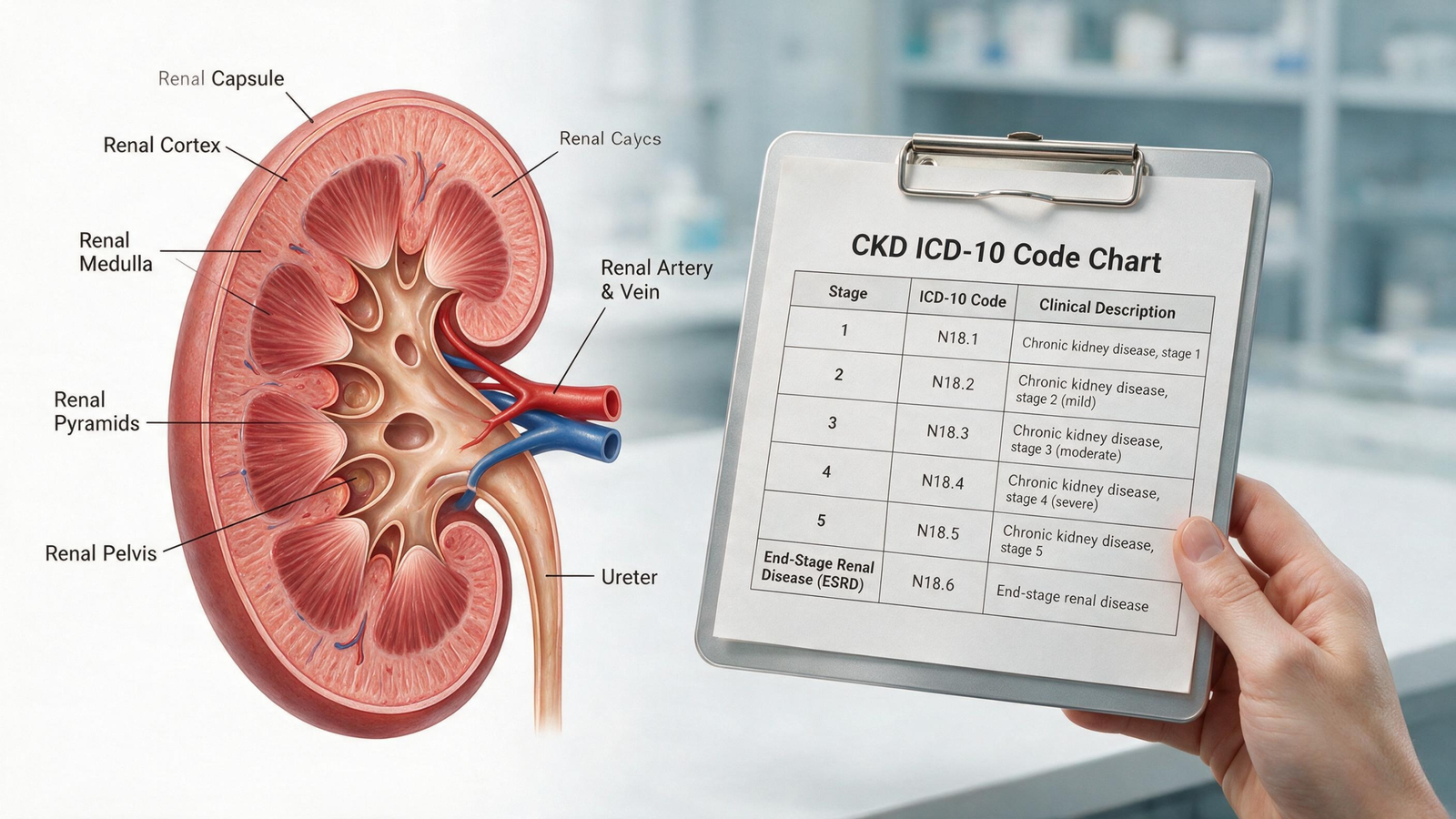
Quick Answer: CKD stages use codes N18.1 through N18.6, with N18.6 reserved specifically for ESRD (dialysis/transplant status). N18.9 is only for undocumented/unspecified stage not a “default” code. Full chart below.
Quick-Answer Code Chart
Here’s the table I keep pinned above my monitor. Bookmark this section it answers 90% of what you searched for.
| Code | Stage | Meaning |
|---|---|---|
| N18.1 | Stage 1 | Kidney damage, normal GFR (≥90) |
| N18.2 | Stage 2 | Mild reduction, GFR 60–89 |
| N18.30 | Stage 3, unspecified | GFR 30–59, not split further in the chart |
| N18.31 | Stage 3a | GFR 45–59 |
| N18.32 | Stage 3b | GFR 30–44 |
| N18.4 | Stage 4 | Severe, GFR 15–29 |
| N18.5 | Stage 5 | GFR under 15, not yet on dialysis |
| N18.6 | ESRD | Kidney failure requiring dialysis or transplant |
| N18.9 | Unspecified | No documented stage in the chart |
Notice something? N18.9 isn’t “stage 6.” It’s not a stage at all it’s what you use when the physician never documented one. Don’t default to it just because it’s fast.
What Each Stage Code Actually Means
(Coding/administrative perspective only — not clinical guidance)
N18.1 — Stage 1
The kidneys show damage usually protein in the urine or a structural abnormality on imaging — but filtration is still normal. Patients rarely feel sick at this point. I’ve seen this get missed entirely because nothing “obvious” shows up on labs besides a slightly elevated albumin-to-creatinine ratio.
N18.2 — Stage 2 (Mild)
GFR between 60 and 89. Still mostly asymptomatic. The chart usually shows this alongside a diabetes or hypertension diagnosis, since those two conditions cause the majority of CKD cases in the U.S.
N18.30, N18.31, N18.32 — Stage 3
This is where I see the most billing errors. If the provider’s note just says “CKD stage 3” without a or b, you code N18.30. If they specify 3a (GFR 45–59) or 3b (GFR 30–44), use the matching sub-code. Auditors check this one closely because reimbursement models increasingly weight severity.
N18.4 — Stage 4 (Severe)
GFR 15–29 falls into Stage 4. In documentation terms, this is typically when charts show nephrology referral activity and dialysis-access planning notes. (This is a coding/administrative observation, not clinical guidance — treatment decisions belong to the patient’s care team.)
N18.5 — Stage 5
GFR under 15 but the patient is not yet on dialysis. This distinction matters don’t jump to N18.6 just because the patient is documented as severely impaired. Confirm dialysis or transplant status first.
N18.6 — ESRD Explained
ESRD isn’t a lab value — it’s a clinical status. Once a patient starts dialysis (or receives a transplant), you code N18.6, regardless of their most recent GFR reading. I’ve had physicians push back on this because they’re thinking in stages, not status. Correct them gently — CMS treats ESRD as its own category for a reason, tied to Medicare’s End-Stage Renal Disease Program funding rules.
If the patient is on maintenance dialysis, pair N18.6 with Z99.2 (dependence on renal dialysis). Miss that combo and you’ll see denials tied to medical necessity documentation.
N18.9 — When “Unspecified” Is Actually Correct
Use N18.9 only when the documentation genuinely doesn’t state a stage not because you’re in a hurry. If a lab result showing GFR exists anywhere in the chart, query the provider before defaulting to unspecified.
Combination Coding: Diabetes, Hypertension & CKD
This trips up even experienced coders. ICD-10-CM requires combination codes when CKD is caused by diabetes or hypertension you can’t just stack separate codes side by side.
- Diabetic CKD: use E11.22 (Type 2 diabetes with CKD) plus the specific N18.x stage code.
- Hypertensive CKD: use I12.9 (hypertensive CKD, stage 1–4) or I13.10 (with heart involvement) plus the N18.x code.
Leaving out the combination code, or reversing the sequencing, is one of the most common reasons renal claims bounce back.
Why CKD/ESRD Codes Are an OIG Audit Target
The HHS Office of Inspector General has repeatedly flagged ESRD and dialysis billing in its annual Work Plan — largely because N18.6 combined with Z99.2 triggers a distinct, higher reimbursement tier tied to the Medicare ESRD Program. That makes this specific code pairing a recurring focus in post-payment reviews.
For HIM directors, that means:
- Every N18.6 claim should have a chart note explicitly confirming dialysis or transplant status — not inferred from a low GFR alone
- Combination codes (E11.22, I12.9) need documentation trails showing the causal relationship, not just co-occurring diagnoses
- Random internal audits of N18.x claims quarterly can catch pattern errors before CMS does
Common Denial Triggers & How to Avoid Them
- Missing GFR documentation to support the stage billed
- N18.6 used without Z99.2 for dialysis dependence
- Combination code sequencing errors (E11.22/I12.9 before or after N18.x incorrectly)
- Defaulting to N18.9 when stage data exists elsewhere in the chart
My rule of thumb: if the lab result and the diagnosis note don’t match the stage on the claim, fix it before submission not after the denial.
A Real Coding Example
Last year I worked a chart for a 68-year-old diabetic patient with a GFR of 42. The note said “CKD, diabetic nephropathy.” No dialysis. Here’s how that gets coded correctly:
E11.22 (Type 2 diabetes with CKD) + N18.31 (Stage 3a matching the GFR of 42, which actually falls in 3b territory, so I flagged it back to the provider for a correction to N18.32).
That single catch prevented a downcoded claim and a compliance flag six months later during an internal audit.
FAQs
N18.9 used only when the chart doesn’t document a specific stage.
N18.30 is stage 3 with no sub-stage specified. N18.31 is 3a (GFR 45–59). N18.32 is 3b (GFR 30–44).
No N18.6 specifically means dialysis or transplant status, not just a low GFR. Without dialysis, use N18.5.
Yes, add Z99.2 for dialysis dependence when applicable.
Use E11.22 plus the specific N18.x stage code never N18.x alone if diabetes is the documented cause.
Medical Disclaimer
This article is for educational and administrative billing reference only. It does not replace official CMS/ICD-10-CM guidelines, payer-specific policy manuals, or clinical judgment from a licensed physician. Always verify current-year code updates directly with CMS.gov before billing, and consult a certified coding auditor for facility-specific compliance questions.
About the Author
Mark, CPC, has spent 7+ years in nephrology and renal billing, including six years auditing dialysis claims for a mid-size health system in Ohio. He holds an active AAPC certification and has trained over 200 coders on CKD/ESRD documentation standards.
Medically Reviewed by Dr. Amanda Reyes, MD, board-certified nephrologist practicing in Columbus, Ohio, with 11 years treating CKD and ESRD patients.
References
- Centers for Disease Control and Prevention — Chronic Kidney Disease Surveillance System, cdc.gov/ckd
- Centers for Medicare & Medicaid Services — ICD-10-CM Official Guidelines, cms.gov
- United States Renal Data System (USRDS) Annual Data Report
- HHS Office of Inspector General — Work Plan, ESRD/Dialysis Billing Oversight
- AAPC Knowledge Center — CKD Coding Guidelines