
For calendar year 2027, the standard Medicare Part B monthly premium is $209.40 (up $6.50 from 2026), the annual Part B deductible is $292 (up $9), and the Medicare Part A inpatient hospital deductible is $1,776 per benefit period (up $40). Higher-income beneficiaries with 2025 modified adjusted gross income (MAGI) above $112,000 (individual) or $224,000 (married filing jointly) pay monthly Part B premiums ranging from $293.10 to $711.80, plus Part D surcharges of $15.40 to $96.40, according to official figures released by the Centers for Medicare & Medicaid Services (CMS) on November 17, 2026.
Whether you are checking how much of your 2027 Social Security cost-of-living adjustment remains after Medicare deductions, planning around an income surcharge cliff, or updating front-desk eligibility scripts at a medical practice before January 1, every finalized 2027 dollar figure now sits on the calendar. Below is the complete breakdown, comparing 2026 and 2027 side by side, covering the sub-tables most summaries leave out, and outlining the operational steps healthcare billing teams need for Q1.
| 2027 MEDICARE COSTS AT A GLANCE (OFFICIAL CMS RATES EFFECTIVE JANUARY 1, 2027) Part B Standard Monthly Premium: $209.40 (up 3.2%, or +$6.50 from $202.90 in 2026) Part B Annual Deductible: $292 (up +$9 from $283 in 2026) Part A Inpatient Hospital Deductible: $1,776 per benefit period (up +$40 from $1,736 in 2026) Part A Daily Coinsurance (Days 61 to 90): $444/day | Lifetime Reserve Days (91+): $888/day Skilled Nursing Facility Coinsurance (Days 21 to 100): $222/day (up from $217/day in 2026) First IRMAA Income Threshold (2025 MAGI): Over $112,000 single or $224,000 married filing jointly Part D Standard Cap & Medigap High-Deductible: $2,400 Part D out-of-pocket cap ($700 max deductible); $3,050 Medigap High-Deductible F/G/J threshold |
2026 vs. 2027 Medicare Parts A, B, D & Medigap Cost Comparison
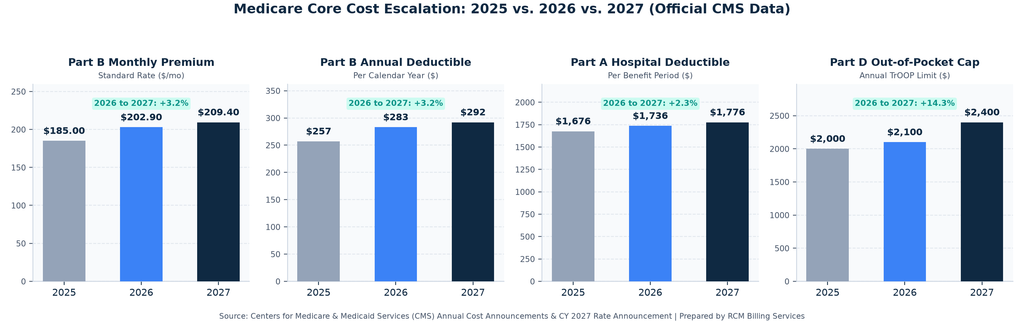
While 2026 saw a sharp jump in Part B premiums, the 2027 increase is comparatively moderate at 3.2% across both the standard Part B premium and annual deductible. However, prescription drug thresholds and high-deductible supplemental limits rose noticeably faster. Review our earlier guides on 2025 Medicare Deductibles and Premiums and 2026 Medicare Parts A & B Premiums and Deductibles to track the three-year trajectory, summarized visually below.
| Medicare Cost Category | 2026 Official | 2027 Official | Dollar Change | How Often It Applies |
|---|---|---|---|---|
| Part B Standard Monthly Premium | $202.90 | $209.40 | +$6.50 / mo | Monthly |
| Part B Annual Deductible | $283 | $292 | +$9 / yr | Once per calendar year |
| Part B Immunosuppressive Drug-Only Premium | Statutory 15% rate | $125.70 | Official 2027 rate | Monthly (36+ mos post-transplant) |
| Part A Inpatient Hospital Deductible | $1,736 | $1,776 | +$40 / period | Per 60-day benefit period |
| Part A Hospital Coinsurance (Days 61 to 90) | $434 / day | $444 / day | +$10 / day | Daily within benefit period |
| Part A Lifetime Reserve Days (Days 91 to 150) | $868 / day | $888 / day | +$20 / day | Daily (60 lifetime days max) |
| Part A Skilled Nursing Facility (Days 21 to 100) | $217 / day | $222 / day | +$5 / day | Daily after 3-day inpatient stay |
| Part A Reduced Buy-In Premium (30 to 39 Quarters) | $311 / mo | $328 / mo | +$17 / mo | Monthly (if <40 work quarters) |
| Part A Full Buy-In Premium (<30 Quarters) | $565 / mo | $597 / mo | +$32 / mo | Monthly (if <30 work quarters) |
| Part D Defined Standard Deductible (Max) | $615 | $700 | +$85 / yr | Annual (varies by plan) |
| Part D Annual Out-of-Pocket Cap (TrOOP) | $2,100 | $2,400 | +$300 / yr | Annual cap on covered Part D drugs |
| Medigap High-Deductible Plans F, G & J | $2,950 | $3,050 | +$100 / yr | Annual out-of-pocket threshold |
| Medigap Plan K / Plan L OOP Limits | $8,000 / $4,000 | $8,360 / $4,180 | +$360 / +$180 | Annual out-of-pocket cap |
2027 Medicare Part A Costs and the 60-Day Benefit Period Trap
Medicare Part A covers inpatient hospital stays, skilled nursing facility (SNF) care following a qualifying hospital admission, hospice services, and certain home health care. Roughly 99% of enrollees pay $0 per month for Part A because they or a spouse accumulated at least 40 quarters (10 years) of Medicare-covered payroll taxes. Beneficiaries who must buy into Part A voluntarily pay $328 per month in 2027 with 30 to 39 work quarters, or $597 per month with fewer than 30 quarters.
Why Part A Costs Can Catch Patients Off Guard
On beneficiary Q&A threads such as Quora, one of the most frequent misconceptions is that Medicare Part A pays 100% of hospital bills or carries a single yearly deductible like commercial insurance. In reality, Part A uses a benefit period (also called a spell of illness) rather than a calendar year. A benefit period starts the day you enter an inpatient hospital or SNF and ends only after you have been out of inpatient hospital or skilled nursing care for 60 consecutive days.
Illustrative Scenario: Suppose a beneficiary enrolled in Original Medicare without Medigap is admitted to the hospital in February 2027 for pneumonia and discharged after four days. They owe the $1,776 Part A deductible for days 1 through 60. If they remain out of the hospital and SNF until June 2027 (more than 60 consecutive days) and are readmitted for hip surgery, a second benefit period starts, triggering a second $1,776 deductible ($3,552 total in Part A deductibles in one year). By contrast, if they are readmitted within 35 days of discharge, they remain in the same benefit period and owe no second deductible.
For extended inpatient stays inside a single benefit period, Medicare charges $444 per day for days 61 through 90, and $888 per day for up to 60 non-renewable lifetime reserve days starting on day 91. Skilled nursing facility care costs $0 for days 1 through 20 and $222 per day for days 21 through 100. For deeper background on how inpatient claims differ from outpatient visits, see our guide on Inpatient vs. Outpatient Billing and Medicare Part A, B, C, and D Services.
2027 Medicare Part B Premiums, Deductible, and Your Social Security COLA
Medicare Part B covers physician visits, outpatient hospital care, ambulatory surgery center procedures, durable medical equipment (DME), lab tests, and Part B-administered drugs. In 2027, the standard monthly Part B premium is $209.40 (up $6.50 from $202.90 in 2026) and the annual calendar-year deductible is $292 (up $9 from $283). After you meet the $292 deductible, Original Medicare generally pays 80% of the Medicare-approved amount, leaving 20% coinsurance with no annual out-of-pocket maximum unless you carry supplemental coverage.
Immunosuppressive Drug-Only Part B Coverage
Individuals whose full Medicare coverage ended 36 months after a kidney transplant and who lack other qualifying coverage can maintain Part B coverage strictly for immunosuppressive drugs. In 2027, CMS set the standard immunosuppressive-only monthly premium at $125.70 (higher for enrollees subject to IRMAA).
How the 3.6% Social Security COLA and Hold-Harmless Rule Interact in 2027
On October 14, 2026, the Social Security Administration (SSA) announced a 3.6% cost-of-living adjustment (COLA) for 2027, lifting the average retired worker’s gross benefit from $2,095 to $2,170 per month (+$75). Because most retirees have Part B premiums deducted directly from their Social Security deposit, the $6.50 Part B increase absorbs roughly 8.7% of an average $75 raise, leaving an average net increase of about $68.50 per month.
Under Section 1839(f) of the Social Security Act, the hold-harmless provision prevents a Part B premium increase from reducing a beneficiary’s net Social Security check below the prior December’s amount. Because a 3.6% COLA adds $36/month even on a $1,000 benefit, almost all standard-premium recipients stay well ahead of the $6.50 increase. However, hold-harmless protection does NOT apply if you:
- Pay an IRMAA surcharge (roughly 9% of Part B enrollees).
- Are newly enrolling in Medicare Part B for 2027 or were not entitled to Social Security benefits for November and December 2026.
- Pay Part B premiums directly (quarterly bills) rather than through Social Security withholding.
- Have your Part B premium paid by a state Medicaid program such as QMB, SLMB, or QI (learn how these programs work in our Medicaid QMB, SLMB, QI, and QDWI guide).
Official 2027 IRMAA Brackets (Part B, Part D, and Filing Statuses)
Income-Related Monthly Adjustment Amounts (IRMAA) apply to roughly 9% of Medicare Part B and Part D beneficiaries, per CMS. Your 2027 IRMAA determination is based on your Modified Adjusted Gross Income (MAGI) from your 2025 federal tax return (adjusted gross income on IRS Form 1040 plus tax-exempt municipal bond interest). The IRS shares this figure with SSA automatically, and SSA mails determination notices each November.
For 2027, inflation indexing pushed the first IRMAA threshold upward by $3,000 for single filers (from $109,000 in 2026 to $112,000 in 2027) and by $6,000 for married couples filing jointly (from $218,000 to $224,000). That means a single retiree with $111,500 in 2025 MAGI pays the standard $209.40 in 2027, whereas the same income triggered Tier 1 surcharges in 2026. Note that Tier 5 ($500,000 single / $750,000 joint) remains statutory and is not inflation-adjusted through 2027.
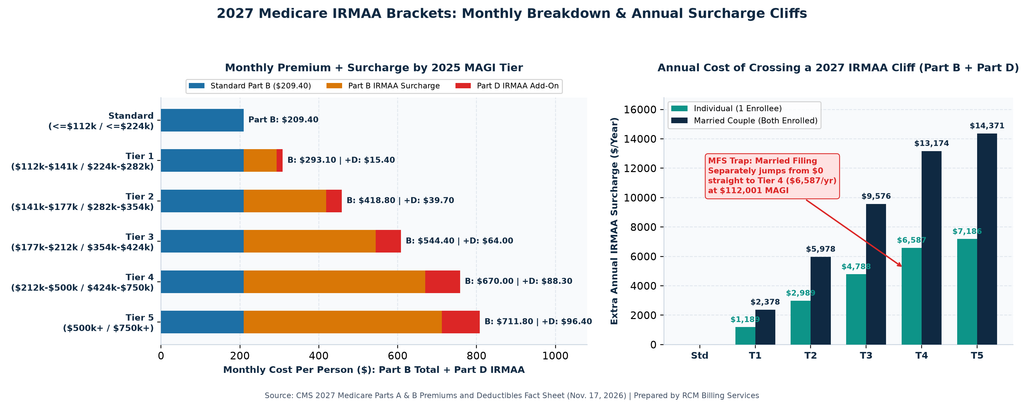
Table 1: 2027 Full Part B & Part D IRMAA Brackets (Single & Married Filing Jointly)
| 2025 MAGI: Individual Return | 2025 MAGI: Joint Return | Part B Surcharge | Total Part B / Mo | Part D Add-On / Mo | Extra Annual Cost (B+D) |
|---|---|---|---|---|---|
| $112,000 or less | $224,000 or less | $0.00 | $209.40 | $0.00 | $0.00 |
| $112,001 to $141,000 | $224,001 to $282,000 | +$83.70 | $293.10 | +$15.40 | $1,189.20 |
| $141,001 to $177,000 | $282,001 to $354,000 | +$209.40 | $418.80 | +$39.70 | $2,989.20 |
| $177,001 to $212,000 | $354,001 to $424,000 | +$335.00 | $544.40 | +$64.00 | $4,788.00 |
| $212,001 to $499,999 | $424,001 to $749,999 | +$460.60 | $670.00 | +$88.30 | $6,586.80 |
| $500,000 or more | $750,000 or more | +$502.40 | $711.80 | +$96.40 | $7,185.60 |
*Note: In a married couple where both spouses are enrolled in Medicare Part B and Part D, each spouse pays the surcharge individually. A couple in Tier 1 pays $2,378.40 in combined extra premiums for the year; a couple in Tier 5 pays $14,371.20 extra per year.*
Table 2: Married Filing Separately (Lived Together Any Time in 2025): The Hidden Cliff
Most competitor guides skip the separate-filer table, yet it carries the steepest penalty in Medicare. If you were married, lived with your spouse at any point during 2025, and filed a separate tax return, Tiers 1, 2, and 3 disappear. Crossing $112,000 by even $1 pushes you straight into Tier 4.
| 2025 MAGI (Married Filing Separately) | Part B IRMAA Surcharge | Total Part B / Mo | Part D Add-On / Mo | Extra Annual Cost (B+D) |
|---|---|---|---|---|
| $112,000 or less | $0.00 | $209.40 | $0.00 | $0.00 |
| $112,001 to $387,999 | +$460.60 | $670.00 | +$88.30 | $6,586.80 |
| $388,000 or more | +$502.40 | $711.80 | +$96.40 | $7,185.60 |
Table 3: 2027 Part B Immunosuppressive Drug-Only IRMAA Schedule
| 2025 MAGI: Individual | 2025 MAGI: Joint Return | 2025 MAGI: Separate (Lived Together) | IRMAA Add-On | Total Monthly Premium |
|---|---|---|---|---|
| $112,000 or less | $224,000 or less | $112,000 or less | $0.00 | $125.70 |
| $112,001 to $141,000 | $224,001 to $282,000 | Not applicable | +$83.70 | $209.40 |
| $141,001 to $177,000 | $282,001 to $354,000 | Not applicable | +$209.40 | $335.10 |
| $177,001 to $212,000 | $354,001 to $424,000 | Not applicable | +$335.00 | $460.70 |
| $212,001 to $499,999 | $424,001 to $749,999 | $112,001 to $387,999 | +$460.60 | $586.30 |
| $500,000 or more | $750,000 or more | $388,000 or more | +$502.40 | $628.10 |
Real Beneficiary Pain Points: The $1 IRMAA Cliff and Form SSA-44 Appeals
Across public Medicare discussions on Reddit (r/medicare and r/DIYRetirement) and Quora, the same three real-world surprises surface every November when SSA determination letters arrive:
- The $1 Cliff Shock: Unlike federal income tax brackets, IRMAA is not graduated. Earning $112,001 instead of $112,000 on a 2025 single return (or $224,001 joint) triggers the entire Tier 1 jump: +$1,189.20 per year for one enrollee, or +$2,378.40 for a couple, for that single dollar over the line.
- The Two-Year Lookback & Year-Two Re-Filing Trap: Many retirees appeal their first-year IRMAA after leaving work, then feel blindsided when a new IRMAA bill arrives the following year. Because 2027 premiums still look back to 2025 tax returns, someone who retired in late 2025 or early 2026 often must file Form SSA-44 a second time so SSA uses estimated 2026 or 2027 MAGI instead of peak working-year 2025 wages.
- One-Time Capital Gains vs. Qualifying Life Events: Selling a rental property, exercising stock options, or completing a large Roth conversion in 2025 does not qualify for an SSA-44 appeal by itself. Only specific life-changing events listed by SSA qualify.
How to Appeal 2027 IRMAA Using Form SSA-44
If your 2025 income was higher than your current income due to one of Social Security’s seven qualifying life-changing events, you can request a recalculation using Form SSA-44 (Medicare Income-Related Monthly Adjustment Amount Life-Changing Event), typically within 60 days of receiving your notice (though late filings with valid documentation are often reviewed):
- Qualifying Events: Marriage; divorce or annulment; death of a spouse; work stoppage (retirement); work reduction; loss of income-producing property due to disaster or other event beyond your control; or loss/reduction of certain pension income (plus employer settlement payments in narrow cases).
- What to Prepare: Proof of the event (such as a retirement letter, separation verification, marriage certificate, or death certificate) plus a reasonable estimate of your 2026 or 2027 MAGI in Steps 2 and 3 of the form.
- Filing & Refunds: Beneficiaries can upload Form SSA-44 through their ssa.gov account, mail or fax it, or drop it off at a local Social Security office. Once approved, SSA adjusts future monthly withholdings and credits or refunds any excess IRMAA already paid for the year.
How 2027 Part D and Medigap Thresholds Change Out-of-Pocket Exposure
Knowing your Part A and Part B numbers is only half of budgeting for 2027. Supplemental Medigap policies and Part D drug plans absorb or cap the remaining risk:
- Medigap Plan G and Plan N: Standard Plan G covers 100% of the $1,776 Part A hospital deductible, hospital coinsurance ($444/$888), SNF coinsurance ($222/day), and Part B’s 20% coinsurance, leaving the beneficiary responsible only for the $292 annual Part B deductible. Plan N adds minor copays (up to $20 for office visits and up to $50 for ER visits if not admitted) and does not cover Part B excess charges. Compare options in our Medigap Plan G vs. N guide and Medigap Overview.
- Medigap High-Deductible Plans F, G, and J: CMS raised the 2027 annual deductible for these high-deductible options to $3,050 (up 3.4% from $2,950 in 2026). Your $292 Part B deductible and $1,776 Part A deductible count toward reaching that $3,050 threshold, after which the plan pays 100% of covered Medicare cost-sharing for the remainder of 2027.
- Medigap Plans K and L: CMS set 2027 annual out-of-pocket maximums at $8,360 for Plan K (which covers 50% of most cost-sharing until the limit is met) and $4,180 for Plan L (which covers 75% until the limit is met).
- Part D Prescription Cap ($2,400): Under the CY 2027 CMS Rate Announcement, the maximum Part D defined standard deductible increases to $700 (from $615) and the annual Part D out-of-pocket cap rises to $2,400 (from $2,100 in 2026). Once covered drug spending reaches $2,400, enrollees enter catastrophic coverage with $0 out-of-pocket cost-sharing for covered Part D medications for the rest of 2027.
For Healthcare Practices & Billing Teams: 2027 Q1 Medicare RCM Playbook
Every January, the reset of the $292 Part B annual deductible and the $1,776 Part A benefit-period deductible triggers a predictable spike in patient balances, front-desk collection friction, and avoidable coordination-of-benefits denials. While consumer Medicare sites stop at personal budgeting, medical practices, ambulatory surgery centers (ASCs), and hospital revenue cycle teams should update five operational checkpoints before January 1, 2027.
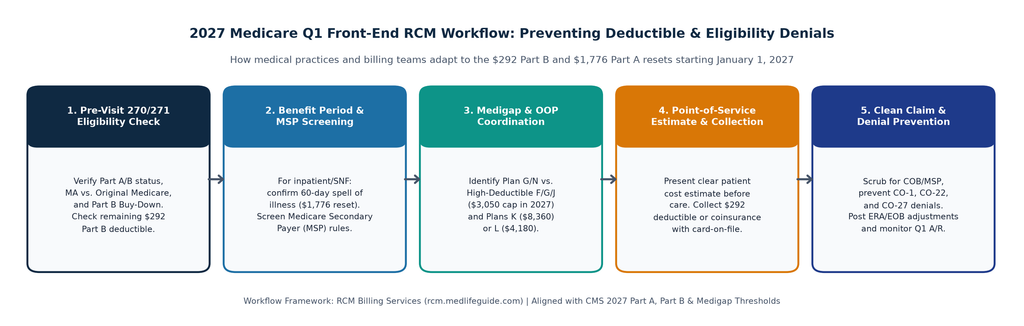
- 1. Refresh Practice Management (PMS) & Estimator Fee Tables: Update your 2027 Part B deductible threshold ($292) and Part A cost-sharing schedules ($1,776 / $444 / $222) in your EHR patient estimator and clearinghouse rules before January 1 claims drop. Review our Patient Access and Registration guide for intake best practices.
- 2. Verify Original Medicare vs. Medicare Advantage & Part B Buy-Downs: Many patients assume a Medicare card means Original Medicare when they actually hold a Part C Medicare Advantage plan (some of which include Part B premium buy-downs). Running automated ANSI 270/271 checks prevents submitting to the wrong payer and avoids CO-22 Coordination of Benefits denials and CO-27 Expenses Incurred After Coverage Terminated denials.
- 3. Confirm Part A 60-Day Benefit Period Status & MSP Rules: Hospital and SNF admission teams should check the beneficiary’s Common Working File (CWF) eligibility response to verify whether a previous 60-day spell of illness has closed before quoting the $1,776 deductible. Also confirm Medicare Primary Payer Rules when working-aged patients or spouse employer plans are active.
- 4. Separate Plan G/N from High-Deductible Medigap ($3,050) at Check-In: Front-desk staff often waive Q1 deductible collection when they see any Medigap policy on file. In 2027, patients on Plan G, Plan N, or High-Deductible Plan G ($3,050) still owe the $292 Part B deductible directly until met. Verify remaining Part B deductible status before collecting so you neither under-collect nor over-collect (requiring costly reversals and refunds).
- 5. Tighten Point-of-Service Collection & Clean Claim Scrubbing: Provide clear pre-visit estimates, use card-on-file agreements compliant with Patient Financial Services best practices, and audit early-January ERA/EOB postings to separate true patient deductible responsibility (PR-1) from payer rejections. See also our guides on Deductible vs. Out-of-Pocket Maximum and Copay vs. Coinsurance.
Recommended Video Explainers & Further Reading
Prefer a quick visual walkthrough of the November 17, 2026 CMS announcement? These newly published video breakdowns summarize the 2027 Part B premium, deductible, and IRMAA updates:
- OFFICIALLY RELEASED! 2027 Medicare Premiums & IRMAA Amounts (YouTube, Nov. 18, 2026): Covers 2027 Part A, Part B, Part C, and Part D cost updates and IRMAA tiers.
- 2027 Medicare Premiums Are Out: Here’s How Much They Went Up (YouTube, Nov. 18, 2026): Walks through out-of-pocket impacts of the $209.40 Part B rate and $292 deductible.
- BREAKING: It’s Official! Medicare 2027 Changes Are Here (YouTube, Nov. 18, 2026): Concise summary of the CMS November 17 announcement for 2027 enrollment planning.
For foundational billing and eligibility rules on this site, explore Medicare Eligibility Criteria and our Denial Code CO-7 Patient Gender/Info Mismatch Guide.
Frequently Asked Questions: 2027 Medicare Costs & IRMAA
Federal rules require Social Security to use the most recent verified tax return provided by the IRS when calculating annual Medicare premiums each fall. Because 2026 tax returns are not filed until spring 2027, SSA uses your 2025 MAGI as the baseline for 2027 premiums. If your income dropped due to retirement or another qualifying life-changing event, file Form SSA-44 with an estimate of your lower current-year MAGI.
Yes. Even if your Medicare Advantage plan advertises a $0 monthly plan premium, you must still pay the Medicare Part B monthly premium ($209.40 standard in 2027, plus any applicable IRMAA surcharge) unless your Part C plan explicitly offers a Part B premium giveback or buy-down benefit.
IRMAA brackets operate as hard cliffs rather than marginal tax brackets. Crossing $112,000 (single) or $224,000 (married filing jointly) by $1 places you in Tier 1 for the entire calendar year, adding $83.70/month to Part B and $15.40/month to Part D ($1,189.20/year per person). Married couples filing separately who lived together at any point in 2025 jump from $0 surcharge at $112,000 straight to $6,586.80/year at $112,001.
No. Federal law prohibits Medigap Plan G (and Plan N) from covering the annual Part B deductible for beneficiaries newly eligible on or after January 1, 2020. Plan G pays 100% of the $1,776 Part A hospital deductible and Part B 20% coinsurance, while you pay the first $292 of Part B services yourself. Only legacy Plan F and Plan C (for pre-2020 eligibles) cover the Part B deductible.
Run real-time 270/271 eligibility verification before the appointment to see the remaining Part B deductible balance, verify whether a secondary Medigap plan covers it (most do not), provide a written estimate, and collect the patient responsibility at check-in or secure an authorized card-on-file.
Your Next Step for 2027
For Medicare Beneficiaries: Log in to your ssa.gov account to review your 2027 COLA and Part B withholding notice, confirm whether your 2025 MAGI puts you near an IRMAA cliff, and submit Form SSA-44 promptly if you experienced retirement or another qualifying income drop.
For Healthcare Practices, Clinics & ASCs: Do not let the January 1 deductible reset inflate your Q1 days in A/R or write-offs. If your team needs automated eligibility verification, clean claim scrubbing, and proactive denial prevention ahead of 2027, request a Free Billing & Q1 Eligibility Audit with RCM Billing Services today.
| INFORMATIONAL & COMPLIANCE NOTICEThis guide is provided for general educational and revenue cycle informational purposes based on federal Medicare announcements published as of November 22, 2026. It does not constitute personalized tax, legal, financial, or medical coverage advice. Beneficiaries should verify individual premium notices with the Social Security Administration (ssa.gov) or Medicare.gov, and healthcare providers should confirm payer-specific coordination rules prior to claim submission. |
Sources
1. Centers for Medicare & Medicaid Services (CMS). 2027 Medicare Parts A & B Premiums and Deductibles (Fact Sheet, CMS-8092-N, CMS-8093-N, CMS-8094-N). Published November 17, 2026. https://www.cms.gov/newsroom/fact-sheets/2027-medicare-parts-b-premiums-deductibles
2. Centers for Medicare & Medicaid Services (CMS). Announcement of Calendar Year (CY) 2027 Medicare Advantage (MA) Capitation Rates and Part C and Part D Payment Policies. Published April 6, 2026. https://www.cms.gov/files/document/2027-announcement.pdf
3. Centers for Medicare & Medicaid Services (CMS). Deductible Amount for Medigap High Deductible Options F, G & J for Calendar Year 2027. Published October 2026. https://www.cms.gov/files/document/cy-2027-medigap-high-deductible-options-fjg.pdf
4. Centers for Medicare & Medicaid Services (CMS). Out-of-Pocket Limits for Medigap Plans K & L for Calendar Year 2027. Published October 2026. https://www.cms.gov/files/document/cy-2027-oop-limits-medigap-plans-kl.pdf
5. Social Security News. Will Your 2027 COLA Cover the Medicare Hike? (3.6% COLA & 42 U.S.C. 1395r(f) Hold-Harmless Analysis). November 20, 2026. https://socialsecuritynews.com/news/2027-medicare-part-b-premium-and-your-cola
6. TheStreet. Medicare’s 2027 Part B premium rises to $209.40 (Average Retired Benefit & Net COLA Impact). November 19, 2026. https://www.thestreet.com/retirement/medicare-part-b-premium-2027-increase
7. Reddit r/medicare Community Discussion. IRMAA and SSA-44 Appeals. January 9, 2026. https://www.reddit.com/r/medicare/comments/1q88r26/irrma_ssa44/
8. Reddit r/DIYRetirement Community Discussion. IRMAA in the second year after retirement. September 8, 2025. https://www.reddit.com/r/DIYRetirement/comments/1nbodof/irmaa_in_the_second_year_after_retirement/
9. Quora Community Q&A. Does Medicare cover 100 percent of hospital bills? https://www.quora.com/Does-Medicare-cover-100-percent-of-hospital-bills
10. YouTube Explainer 1 (Nov. 18, 2026): https://www.youtube.com/watch?v=yPtufM2B4eg
11. YouTube Explainer 2 (Nov. 18, 2026): https://www.youtube.com/watch?v=Y8dOUke6y7E
12. YouTube Explainer 3 (Nov. 18, 2026): https://www.youtube.com/watch?v=XpouN5wkZc0