Medically Reviewed and Compiled by Dr. Adam N. Khan, MD.
National Correct Coding Initiative (NCCI) edits are coding rules developed by the Centers for Medicare & Medicaid Services (CMS) to promote accurate medical billing and prevent improper payments. These edits help healthcare providers, coders, billers, and organizations submit claims that correctly reflect the services performed for patients. NCCI edits are widely used throughout the United States healthcare system and play a major role in Medicare claims processing.
Understanding What is NCCI Edits and its Three Types? is essential for medical practices, hospitals, ambulatory surgery centers, and billing professionals because coding errors can result in claim denials, payment delays, audits, and compliance risks.
This article explains NCCI edits, their three major types, how they work, why they matter, and practical steps for maintaining coding compliance.
What Are NCCI Edits?
The National Correct Coding Initiative (NCCI) was established by CMS in 1996 to reduce inappropriate Medicare payments resulting from incorrect coding combinations. The initiative identifies code pairs and billing situations that should not normally be reported together under standard medical practice.
NCCI edits are based on:
- National coding standards
- Current Procedural Terminology (CPT) guidelines
- Medical and surgical standards of care
- Medicare payment policies
- Clinical practice recommendations
The primary goals of NCCI edits are to:
- Improve coding accuracy
- Prevent duplicate billing
- Reduce fraud, waste, and abuse
- Support correct reimbursement
- Promote compliance with federal regulations
When a claim contains codes that violate NCCI rules, the claim may be denied, reduced, or require additional documentation.
Why NCCI Edits Are Important
Healthcare reimbursement depends heavily on accurate coding. Even small coding mistakes can lead to financial and compliance consequences.
Benefits of NCCI edits include:
- More accurate claim submissions
- Reduced billing errors
- Improved payment integrity
- Better audit readiness
- Consistent coding practices across healthcare organizations
CMS reports that NCCI edits help identify inappropriate code combinations before payment is made, improving the overall integrity of the Medicare program.
What Is NCCI Edits and Its Three Types?
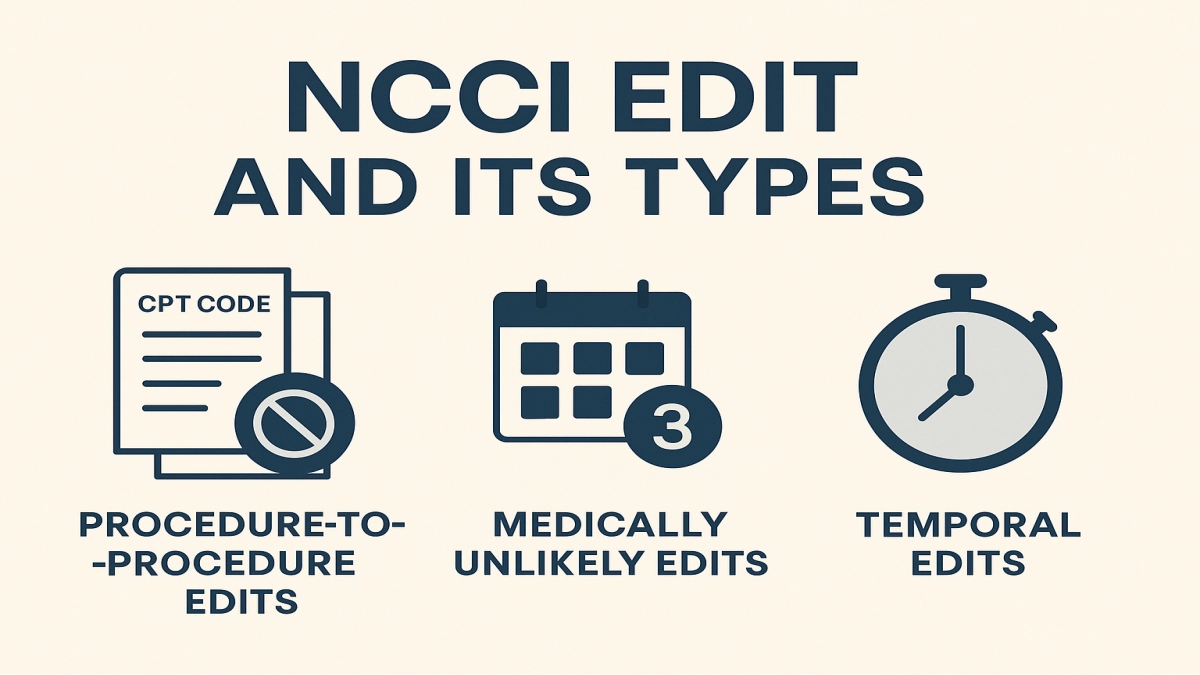
There are three major categories of NCCI edits commonly discussed in medical billing and coding:
- Procedure-to-Procedure (PTP) Edits
- Medically Unlikely Edits (MUEs)
- Add-On Code (AOC) Edits
Each serves a different purpose in claim review and payment determination.
Type 1: Procedure-to-Procedure (PTP) Edits
What Are PTP Edits?
Procedure-to-Procedure edits identify CPT or HCPCS code pairs that generally should not be reported together for the same patient on the same date of service.
PTP edits prevent payment for procedures that are considered:
- Components of a more comprehensive procedure
- Mutually exclusive services
- Services already included within another procedure
How PTP Edits Work
A PTP edit consists of:
- Column One Code: Comprehensive procedure
- Column Two Code: Component procedure
When both codes are billed together, the Column Two code is usually denied because it is already included in the Column One service.
Example
A surgeon performs a comprehensive procedure that already includes a minor related service.
If both procedures are reported separately, the NCCI edit may deny payment for the component code because it is bundled into the larger procedure.
Modifier Use
Certain PTP edits allow the use of approved modifiers, such as:
- Modifier 59
- Modifier XE
- Modifier XS
- Modifier XP
- Modifier XU
These modifiers may be appropriate when documentation proves that separate and distinct services were performed. CMS requires clear medical record support for modifier use.
Key Purpose of PTP Edits
PTP edits help prevent:
- Unbundling
- Duplicate payments
- Incorrect code reporting
- Overbilling
Type 2: Medically Unlikely Edits (MUEs)
What Are MUEs?
Medically Unlikely Edits establish the maximum number of units that a provider would normally report for a specific service for a single patient on a single day.
MUEs help identify billing situations that may represent:
- Data entry errors
- Coding mistakes
- Unusual billing patterns
- Potential overutilization
How MUEs Work
CMS assigns a maximum allowable unit value to many CPT and HCPCS codes.
If the submitted units exceed the established MUE value, the claim may be denied or reviewed.
Example
If a procedure is generally performed once per patient encounter, billing multiple units could trigger an MUE denial.
Why MUEs Matter
MUEs improve payment accuracy by:
- Reducing excessive billing
- Identifying coding errors
- Encouraging documentation review
- Supporting compliance efforts
Healthcare organizations should regularly review MUE tables to avoid unnecessary claim rejections.
Type 3: Add-On Code (AOC) Edits
What Are Add-On Code Edits?
Add-On Code edits ensure that certain CPT add-on services are billed only when an appropriate primary procedure code is also reported.
An add-on code represents additional work associated with a primary service.
How AOC Edits Work
CMS reviews claims to confirm that:
- The primary procedure is present
- The add-on code is clinically appropriate
- Coding guidelines are followed
Example
A physician performs a primary procedure and an additional service that qualifies as an add-on code.
If the add-on code is submitted without the required primary code, payment may be denied.
Benefits of AOC Edits
Add-On Code edits help:
- Ensure coding accuracy
- Prevent unsupported billing
- Improve claim consistency
- Reduce payment errors
How NCCI Edits Affect Healthcare Providers
NCCI edits influence many aspects of healthcare operations.
Financial Impact
Incorrect coding may result in:
- Claim denials
- Delayed reimbursement
- Revenue loss
- Increased administrative work
Compliance Impact
Failure to follow NCCI rules may increase the risk of:
- Medicare audits
- Compliance investigations
- Repayment demands
Operational Impact
Healthcare organizations often invest in:
- Coding education
- Compliance programs
- Electronic claim review systems
- Internal audits
These efforts help reduce coding errors before claims are submitted.


How NCCI Edits Affect Patients
Although NCCI edits are primarily billing tools, they can indirectly affect patients.
Reduced Billing Errors
Accurate coding helps ensure:
- Correct insurance processing
- Appropriate patient responsibility
- Fewer billing disputes
Improved Documentation
Providers must maintain detailed medical records to support coding decisions.
This can improve communication among healthcare professionals and strengthen continuity of care.
Better Program Integrity
By reducing improper payments, NCCI edits support responsible use of Medicare resources, which benefits healthcare systems and patients nationwide.
Unique Clinical Takeaways
Clinical Takeaway 1: Documentation Often Determines Whether Separate Procedures Can Be Paid
Many claim denials occur not because a service was medically unnecessary but because documentation fails to demonstrate that separate procedures were truly distinct.
Providers should clearly document:
- Different anatomical sites
- Separate encounters
- Independent clinical indications
- Distinct procedural work
Strong documentation is often the deciding factor when modifiers are used to bypass allowable PTP edits. CMS specifically emphasizes medical record support for modifier application.
Clinical Takeaway 2: High Denial Rates May Signal Workflow Problems Rather Than Coding Knowledge Gaps
Repeated NCCI denials can indicate system-wide issues such as:
- Poor charge capture processes
- Electronic health record template errors
- Inadequate coder-provider communication
- Missing compliance reviews
Organizations that analyze denial trends often discover operational weaknesses that extend beyond individual coding mistakes.
Routine denial tracking can identify recurring problems before they affect revenue and compliance performance.
Clinical Takeaway 3: Specialty-Specific Risk Profiles Require Customized Monitoring
Different medical specialties face different NCCI risks.
Examples include:
- Surgery practices encountering PTP edit challenges
- Radiology groups dealing with bundled imaging services
- Pain management clinics facing modifier scrutiny
- Dermatology offices managing multiple procedure billing
A specialty-focused audit strategy is often more effective than using a generic compliance approach.
Clinical Takeaway 4: Modifier Misuse Remains a Major Audit Concern
CMS and the Office of Inspector General have repeatedly emphasized accurate modifier reporting.
Using modifiers simply to obtain payment without supporting documentation can increase audit exposure.
Best practices include:
- Regular staff training
- Internal chart reviews
- Modifier-specific compliance monitoring
- Documentation validation before claim submission
Common Reasons NCCI Edits Trigger Claim Denials
Several issues commonly lead to denials.
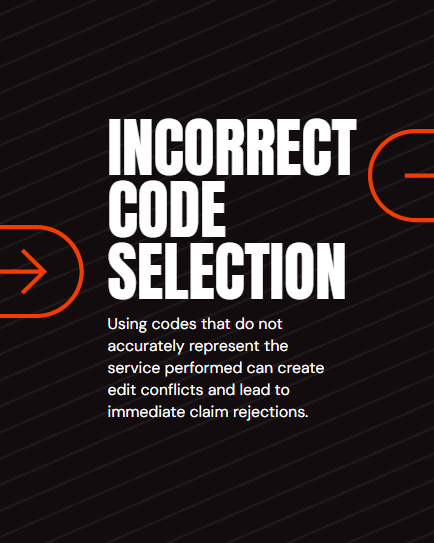
Incorrect Code Selection
Using codes that do not accurately represent the service performed can create edit conflicts.
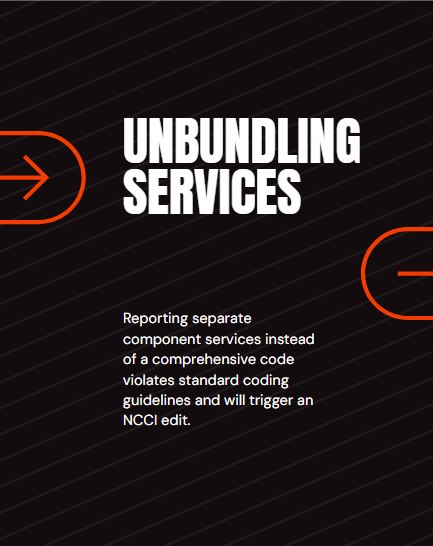
Unbundling
Reporting separate component services instead of a comprehensive code violates coding standards.
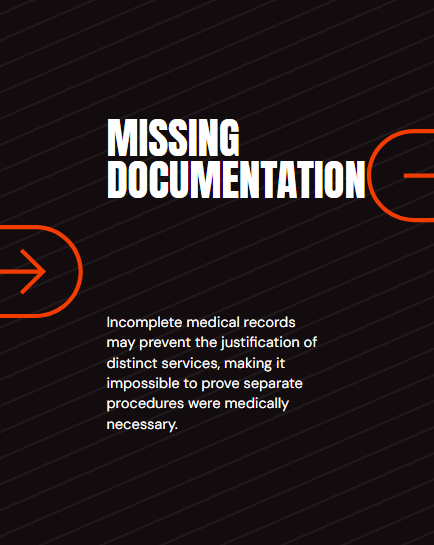
Missing Documentation
Incomplete records may prevent justification of distinct services.
Excessive Units
Billing units above established MUE thresholds may trigger rejection.
Improper Modifier Use
Unsupported modifier use is a frequent source of claim denial and audit concern.
Best Practices for NCCI Compliance
Stay Current With CMS Updates
CMS regularly updates NCCI edit files.
Practices should review updates on a routine basis.
Conduct Internal Audits
Regular audits help identify:
- Coding errors
- Modifier misuse
- Documentation weaknesses
Provide Ongoing Education
Training should include:
- CPT coding guidelines
- HCPCS coding updates
- Modifier usage rules
- NCCI policy changes
Improve Documentation Quality
Medical records should clearly explain:
- Clinical necessity
- Procedure details
- Distinct services when applicable
Use Claim Scrubbing Software
Many billing systems automatically identify NCCI conflicts before claims are submitted.
Differences Between NCCI Edits and Other Coding Rules
| Feature | NCCI Edits | General CPT Rules |
|---|---|---|
| Purpose | Prevent improper payments | Standard coding guidance |
| Managed By | CMS | American Medical Association |
| Focus | Claim review and payment integrity | Procedure reporting |
| Updates | Regular CMS releases | Annual CPT revisions |
| Medicare Use | Extensive | Supports coding framework |
Both systems work together to support accurate healthcare billing.
Challenges Healthcare Organizations Face With NCCI Edits
Common challenges include:
- Frequent regulatory updates
- Complex modifier requirements
- Large claim volumes
- Staff turnover
- Documentation inconsistencies
Organizations with strong compliance programs are generally better positioned to manage these challenges effectively.
Frequently Asked Questions (FAQs)
NCCI stands for National Correct Coding Initiative, a CMS program designed to improve coding accuracy and prevent improper Medicare payments.
The three major types are:
Procedure-to-Procedure (PTP) Edits
Medically Unlikely Edits (MUEs)
Add-On Code (AOC) Edits
Some PTP edits may be bypassed using approved modifiers when documentation supports separate and distinct services. Not all edits can be overridden.
MUEs occur when billed units exceed the maximum number CMS considers medically reasonable for a patient on a single day.
Medicare providers are directly affected by NCCI edits, and many commercial payers also use similar editing systems based on NCCI principles.
References and Citations
Internal Citation Links Used in Article
- Centers for Medicare & Medicaid Services (CMS) – National Correct Coding Initiative (NCCI) Program
- CMS – NCCI Policy Manual for Medicare Services
- CMS – Medically Unlikely Edits (MUE) Program Guidance
- American Medical Association (AMA) – CPT Professional Coding Guidance on Add-On Codes
- U.S. Department of Health and Human Services Office of Inspector General (OIG) – Medicare Coding and Modifier Compliance Reports
Medical Disclaimer
This article is intended for educational and informational purposes only. It does not constitute medical, legal, coding, billing, reimbursement, or compliance advice. Coding regulations and CMS policies may change over time. Healthcare professionals, medical coders, and billing specialists should consult the latest CMS guidance, CPT manuals, payer policies, and qualified compliance experts before making coding or reimbursement decisions. Always verify current requirements with official regulatory sources.