AI is replacing some medical billing tasks, especially repetitive, rules-based work. It is not making every medical biller, coder, or revenue cycle professional unnecessary. The more realistic change is a shift from entering, chasing, and sorting routine work toward validating outputs, resolving exceptions, preventing denials, protecting compliance, and improving the revenue cycle.
That distinction matters if you are deciding whether to train for billing, introduce AI into a practice, or choose an RCM vendor. A system may verify eligibility, flag a missing field, or draft a denial appeal quickly. It cannot make an unsupported claim valid, settle an ambiguous medical record, or transfer accountability away from the provider or billing organization.
For a broad labor-market signal, the U.S. Bureau of Labor Statistics projects medical records specialist employment to grow 8% from 2025 to 2035, while also noting that AI-powered tools may affect demand by making medical coding more efficient. This category is an imperfect proxy because it includes more than billers and coders, but it is much more useful than a blanket claim that the profession is either safe or finished. BLS: Medical Records Specialists
The practical question is not, “Will AI replace medical billers?” It is: Which parts of your workflow can be automated without creating more denials, rework, privacy risk, or audit exposure?
Quick answer: Routine, structured billing tasks are the most exposed. Complex coding, documentation clarification, payer-specific exceptions, material appeals, audit review, and accountability are far less suitable for unsupervised automation.
Start with the distinction most articles skip: biller, coder, and RCM specialist
These roles overlap, but they do not do the same work.
- A medical coder translates documented diagnoses, procedures, supplies, and services into standardized codes. Coding requires current code sets, guidelines, documentation interpretation, and, often, specialty knowledge.
- A medical biller turns coded services and supporting information into claims, follows the claim through adjudication, posts payments, works rejections and denials, and helps collect the right amount from the right party.
- An RCM specialist or team may cover front-end registration and eligibility, charge capture, coding, claim edits, prior authorization, billing, payment posting, denial management, appeals, reporting, and patient balances.
The Bureau of Labor Statistics describes medical records specialists as workers who review records, assign or enter coded information, support reimbursement, and safeguard patient information. That breadth is one reason a job title alone does not reveal automation risk. BLS: Medical Records Specialists
For example, a clean claim-status lookup is very different from deciding whether documentation supports a code, identifying a missed charge, or building an appeal around a payer policy. One is structured retrieval. The others require context, judgment, traceability, and sometimes a conversation with a clinician or payer.
What AI can automate well, where it needs review, and where humans lead
AI works best when the task has predictable inputs, defined rules, a limited number of exceptions, and a low cost of error. It becomes less reliable when information is incomplete, a payer rule changes, a code depends on clinical context, or a mistake affects reimbursement, compliance, or patient responsibility.
| RCM task | What AI or automation can reasonably do | Why human review may still be needed | Suggested operating model |
|---|---|---|---|
| Eligibility and benefit checks | Retrieve structured eligibility responses and flag missing data | Coverage details, coordination of benefits, and nonstandard payer responses can require follow-up | Automate with exception queues |
| Demographic and charge-entry validation | Find blank, invalid, duplicate, or mismatched fields | Source data can still be wrong | Automate edits, verify exceptions |
| Claim-status inquiries | Gather status from connected sources and sort worklists | A status message may not explain the next best action | Automate retrieval, assign follow-up rules |
| Payment posting proposals | Match remittance information and suggest posting actions | Contract terms, underpayments, recoupments, and unusual adjustments need review | Automate routine matches, reconcile exceptions |
| Coding suggestions | Surface likely diagnoses, procedures, missing documentation, or edits | A plausible code can still be unsupported, incomplete, outdated, or wrong for the payer context | Assist then review, especially outside narrow validated lanes |
| Claim scrubbing | Flag defined edits before submission | An edit can be bypassed, misconfigured, or insufficient for a real-world coverage rule | Use as preventive control, not final judgment |
| Denial triage | Categorize reason codes, prioritize deadlines, and draft next steps | Appeals depend on the record, payer policy, contract language, and evidence | Assist then review |
| Appeals and complex AR | Draft a starting point and organize supporting records | Legal, clinical, financial, and payer-specific judgment affect strategy | Human-led, with AI support |
| Prior authorization | Identify likely requirements and prepare standard information | Medical necessity, required documentation, and exceptions can be consequential | Automate administration, retain expert review |
| Patient billing communications | Draft plain-language explanations and route questions | A wrong statement can harm trust or misstate responsibility | Use approved templates and escalation rules |
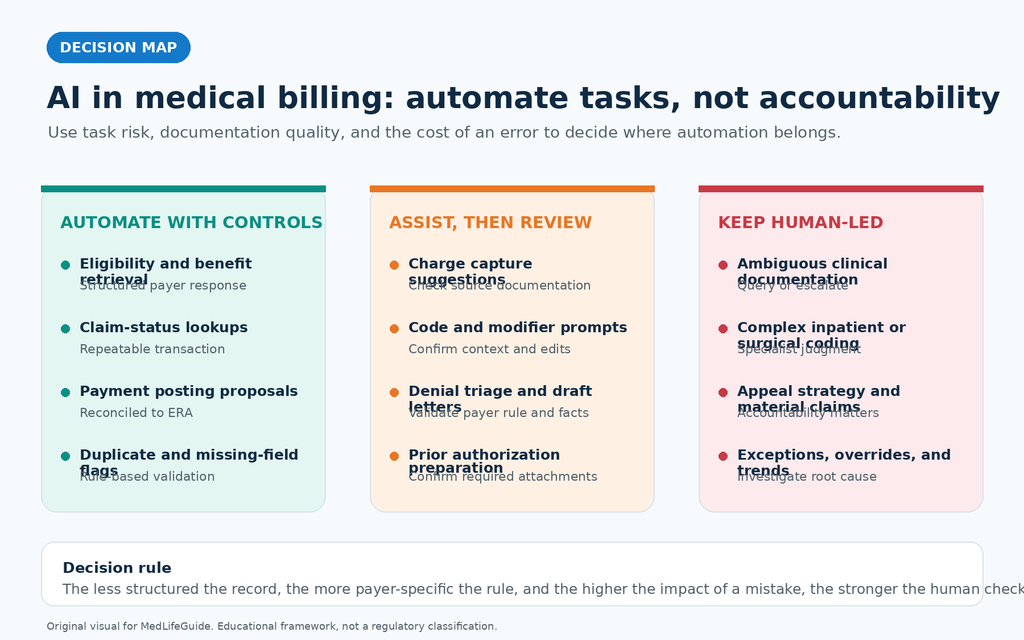
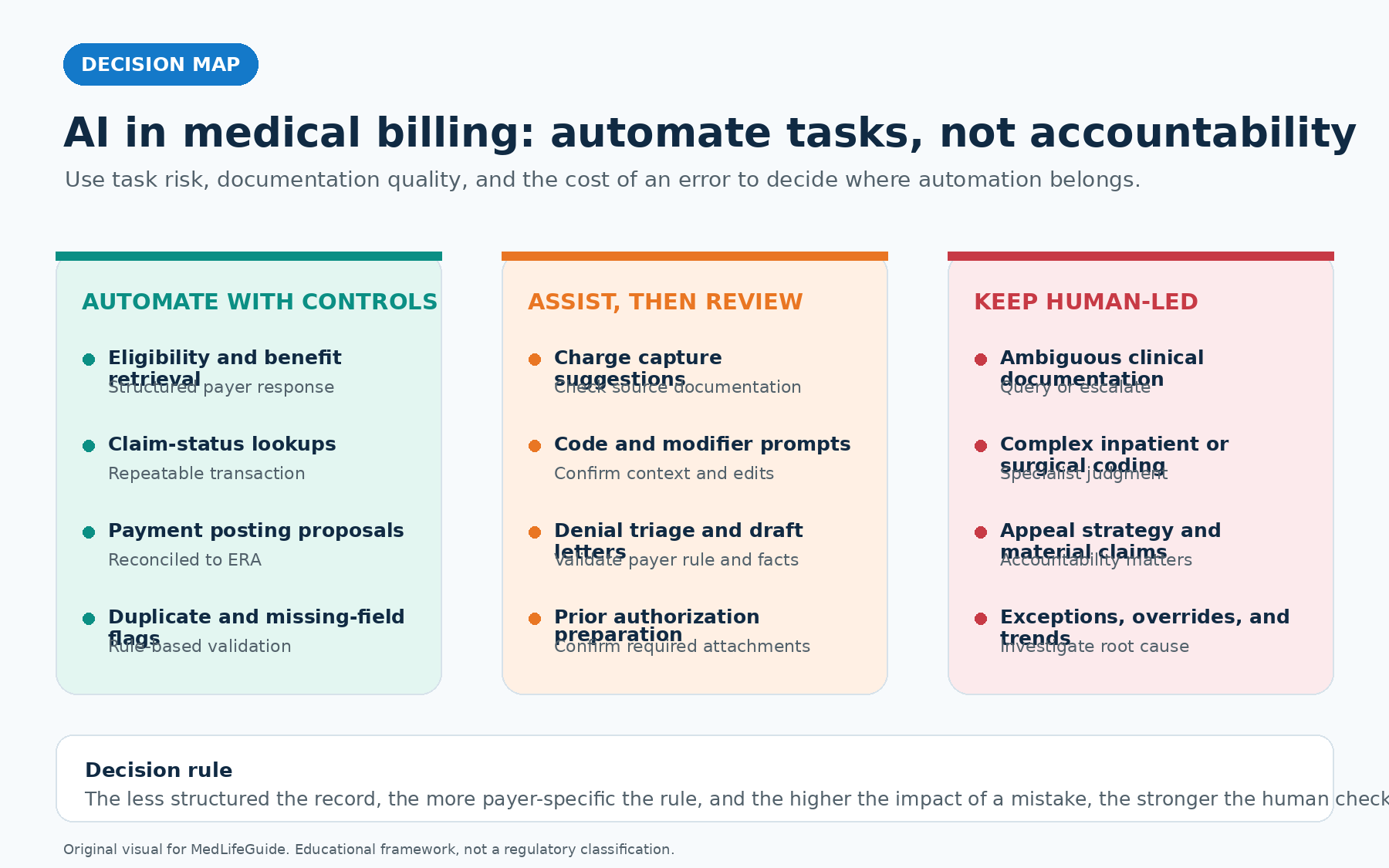
Decision map showing three AI lanes for medical billing tasks: automate with controls, assist then review, and keep human-led.
Figure 1. Original task map for AI-assisted medical billing. It is a practical operating framework, not a legal classification.
A useful warning: vendors often report a single accuracy percentage. Do not treat that number as a buying decision. Ask what encounter types were measured, which specialties and payers were included, whether humans corrected the outputs before scoring, whether missed charges and overcoding were measured separately, and what happened to denials and rework after go-live.
Why medical billing cannot run safely on autopilot
A clean electronic transaction is not the same as a supported claim
Submitting a claim electronically does not make it correct. CMS says health care professionals and suppliers must submit accurate claims, use current diagnosis and procedure codes at the highest available specificity, and maintain documentation supporting coverage and coding requirements. CMS: Medicare Billing, CMS-1500 and 837P
That is the difference between a system that detects a syntax problem and a professional who assesses whether the clinical record, coding rule, modifier, coverage requirement, and payer instruction all support what is billed. An AI tool may speed up the first pass. It does not change the standard applied to the claim.
CMS program-integrity materials also describe review processes that test whether a billed service is documented, reasonable and necessary, and coded correctly. In other words, the downstream question is not whether a person or a model typed the code. It is whether the submitted claim is supportable. CMS: Medicare Program Integrity Manual, Chapter 3
Payer rules, documentation, and exceptions create the hard work
A tool can be excellent at noticing a repeated pattern and still struggle when the record is incomplete or a claim falls outside that pattern. The highest-value human work often sits at the edges:
- identifying where documentation does not support a proposed code
- recognizing a payer-specific rule, contract term, or modifier issue
- choosing when to query, correct, appeal, or escalate
- separating a coding issue from a registration, authorization, medical-necessity, or payment issue
- seeing that a recurring denial is a workflow defect rather than an isolated account problem
- protecting the patient from an inaccurate bill or an avoidable delay
For a practical refresher on pre-bill controls, link readers to NCCI edits and their types. NCCI edits can help prevent certain incorrect code combinations, but they are not a substitute for documentation review or payer-specific judgment.
Privacy and auditability are operational requirements
A claim workflow contains protected health information. If a cloud service provider creates, receives, maintains, or transmits electronic protected health information on behalf of a covered entity or business associate, HHS guidance explains that the relationship generally requires a HIPAA-compliant business associate agreement, alongside appropriate safeguards and risk analysis. HHS OCR: Guidance on HIPAA and Cloud Computing
This is why “we do not train on your data” is not enough due diligence. Before a team enters patient data into an AI product, it should understand the data flow, access controls, subcontractors, retention and deletion terms, incident response, audit-log availability, approved use cases, and who owns the outcome when a recommendation is wrong.
HHS OIG’s General Compliance Program Guidance identifies risk assessment, auditing, monitoring, and corrective action as core parts of an effective compliance program. The guidance is voluntary rather than a one-size-fits-all rule, but it supports a sensible design principle: do not deploy an AI workflow without a way to measure it, investigate it, and correct it. HHS OIG: General Compliance Program Guidance
Is AI reducing medical billing jobs?
It can reduce the volume of routine work and change staffing needs in specific teams. It does not justify a universal prediction that every medical billing role will disappear on a fixed date.
The near-term risk is not evenly distributed. A team that spends most of its day retrieving structured data, checking status, moving clean transactions, or working high-volume standard cases may need fewer people for the same volume after a well-designed automation rollout. A team that manages denials, complex payer behavior, specialty coding, compliance audits, documentation improvement, and patient or provider escalations may see its work shift rather than vanish.
Professional guidance reflects that shift. AHIMA recommends combining technology with experienced coding oversight, targeted auditing, and stronger revenue-cycle literacy. It also warns that AI can create overcoding or undercoding risk if teams do not build meaningful review and feedback loops. AHIMA: Three Essential Strategies for Coding Excellence in the Era of Artificial Intelligence
What practitioners are reporting, and what it does not prove
Public Reddit discussions show two experiences happening at once. Some contributors report that their organizations are automating simple or high-volume work and moving people toward validation, audit, or exception queues. Others report that early tools create enough incorrect suggestions or documentation-context errors that rework offsets the promised gains. r/CodingandBilling: AI Concerns in Medical Coding r/MedicalCoding: Team Got Cut by a Third for AI
These are unverified, self-selected anecdotes. They do not establish national layoff rates, vendor accuracy, or a universal outcome. They are useful for one reason: they identify what a practice should measure during a pilot. Track not just throughput, but also coder overrides, denial patterns, appeal workload, write-offs, corrected-claim deadlines, staff time spent fixing outputs, and the quality of clinician documentation.
The article does not use Quora answers as evidence because authorship, setting, and supporting data are typically not verifiable. That is an editorial choice, not a judgment about individual contributors.
The 2026 to 2027 shift RCM teams should watch
AI is not the only force changing medical billing. Interoperability rules and payer technology are reshaping parts of prior authorization and data exchange.
CMS’s Interoperability and Prior Authorization Final Rule, CMS-0057-F, applies to specified Medicare Advantage organizations, Medicaid and CHIP programs and plans, and qualified health plan issuers on federally facilitated exchanges. It requires certain operational provisions beginning in 2026 and generally requires relevant API development and enhancements beginning in 2027, with exact dates varying by payer type. The rule includes a Prior Authorization API requirement for covered items and services and requires impacted payers to communicate approvals, denials with specific reasons, or requests for more information. CMS: Interoperability and Prior Authorization Final Rule, CMS-0057-F
Do not overstate what that means. It does not make every prior authorization automatic. It does not erase payer rules, documentation requirements, exceptions, or the need for a human to investigate a denial. It does create a strong reason for RCM leaders to improve data quality, map authorization workflows, and decide where staff should handle exceptions rather than routine exchange.
A useful internal link here is eligibility and benefit verification. Readers should understand that front-end coverage verification and prior authorization are related but different control points in the revenue cycle.
A safer way for practices to adopt AI in medical billing
The best first deployment is usually not “automate the whole billing department.” It is a narrow, measurable workflow with a known baseline and an accountable owner.
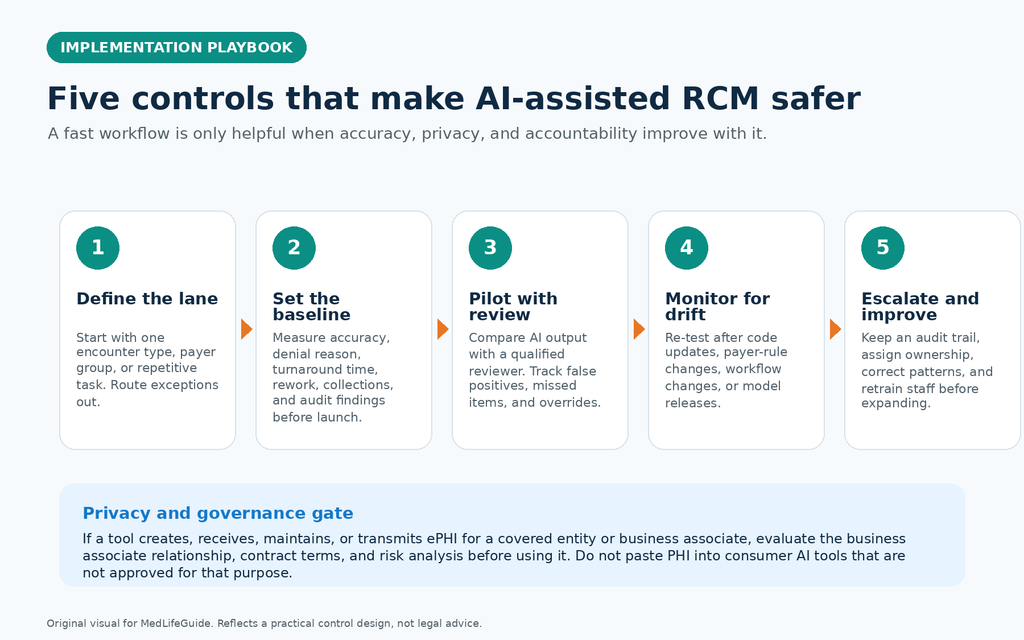
Five-step implementation graphic covering define the lane, set the baseline, pilot with review, monitor for drift, and escalate and improve.
Figure 2. Original AI-assisted RCM control sequence. It is designed for operational discussion, not as legal advice.
Step 1: Choose one narrow lane
Start with one encounter type, payer group, or repetitive task. Good candidates are eligibility retrieval, claim-status routing, payment-posting suggestions, or a defined denial category. Avoid starting with your most complex specialty, a broad auto-submit workflow, or a process where baseline data is unreliable.
Step 2: Build a baseline before the pilot
Measure the existing process for at least one normal operating period. Use metrics that reflect quality as well as speed:
- clean-claim or first-pass acceptance rate
- denial rate by reason and payer
- days in accounts receivable for the selected workstream
- corrected-claim and appeal deadline misses
- coding or billing audit findings
- staff time per account and time spent reworking AI output
- net collections and avoidable write-offs
- provider query volume and documentation defects
Step 3: Review the pilot outputs meaningfully
A person clicking “accept” without access to the source record, coding guidance, or time to investigate is not a meaningful control. Decide which cases must go to credentialed coding, billing, compliance, or clinical documentation staff before launch.
AHIMA notes that CMS materials focus on whether codes are documented and reported correctly rather than creating a separate, universal AI-specific attestation requirement for providers. That does not remove the need for a clear review process, an audit trail, accountable decision-makers, and ongoing sampling. AHIMA: AI Attestation, an Issue Worth Discussing in Coding
Step 4: Test for drift and correlated errors
A human makes individual mistakes. A model, configuration, or reference-data defect can repeat the same mistake at scale. Re-test whenever the vendor changes the model, your EHR workflow changes, a code set changes, a payer changes an edit, a new specialty is added, or denial trends move unexpectedly.
The NIST AI Risk Management Framework is voluntary, but its focus on governing, mapping, measuring, and managing AI risk provides a useful structure for this work. NIST also publishes a Generative AI Profile that addresses risks specific to generative systems. NIST: AI Risk Management Framework
Step 5: Expand only after quality and economics both improve
Do not call a pilot successful because it processes more charts per hour. Expand only if the results show a credible improvement in the measures that matter to your organization, including accuracy, denials, rework, net collections, compliance findings, staff experience, and patient-facing clarity.
Vendor questions that expose weak claims
Ask every vendor to answer these questions in writing:
- Which exact encounter types, specialties, payers, code families, and workflows were used to support your performance claim?
- What does your reported accuracy measure? Does it separately report missed charges, overcoding, undercoding, modifier errors, unsupported diagnoses, and false negatives?
- Were cases reviewed or corrected by humans before the reported score was calculated?
- Can the system show the source record, rule, evidence, confidence signal, user override, and final action for each recommendation?
- How are code updates, payer policies, local coverage requirements, and client-specific rules maintained and tested?
- What is the human-review policy for low-confidence, high-dollar, high-risk, new, or exception cases?
- What data does the product create, receive, maintain, transmit, retain, or use? Will the vendor sign the required BAA where applicable?
- What happens after an error is found? Who investigates the root cause, corrects affected claims, documents the incident, and pays for remediation?
- Can the practice export audit logs and data if the contract ends?
- Which independent customer references match our specialty, payer mix, system, and encounter complexity?
For a related internal resource, link the phrase clearinghouse and payer rejections when discussing how a rejected transaction differs from a denied claim. That distinction helps readers avoid blaming every failure on coding or AI.
How medical billers and coders can become harder to replace
The strongest career strategy is not to compete with software on speed alone. It is to become the person who can tell when a fast answer is unsafe, incomplete, or economically unwise.
Build depth in one or more of these areas:
- Denial prevention and appeals: Learn to interpret remittance codes, payer policies, documentation requirements, appeal deadlines, and root causes.
- Specialty or complex coding: Develop expertise where context, procedures, modifiers, and documentation nuance matter.
- Audit and compliance: Learn how to sample work, document findings, analyze patterns, and build corrective actions.
- Clinical documentation integrity: Improve the quality of the source record before it becomes a claim problem.
- Payer-contract and underpayment analysis: Connect billed services, contract terms, payment variance, and escalation strategy.
- RCM analytics: Use data to identify avoidable denials, aged receivables, missed charges, and workflow defects.
- AI validation and governance: Help test outputs, define review thresholds, record overrides, detect drift, and train staff.
AAPC’s current AI education for coding and billing focuses on AI-assisted workflows, compliance, ethics, data privacy, validation, and quality assurance. That is a useful signal: the market value is moving toward responsible use and verification, not simply knowing how to type a code faster. AAPC: AI-Assisted Medical Coding and Billing, Applied Practice
A practical 90-day plan for a biller or coder
| Timeframe | Practical action | Evidence you can show an employer or manager |
|---|---|---|
| Days 1 to 30 | Map your work into routine, exception, and judgment-heavy tasks. Learn the top denial reasons and payer rules in your queue. | A concise workflow map and a denial root-cause summary. |
| Days 31 to 60 | Choose one adjacent skill: appeals, audit, CDI, a specialty, payment variance, or reporting. Practice on de-identified examples or approved training material. | A mini playbook, audit checklist, or sample appeal workflow. |
| Days 61 to 90 | Volunteer for an automation pilot, quality project, payer-edit review, or denial-prevention initiative. Track baseline and outcome measures. | A before-and-after dashboard, test log, or corrective-action proposal. |
If you are entering the field, do not make a training decision based only on a promise of remote work or a prediction that no job will ever change. Compare local job postings, credential expectations, specialty demand, entry-level hiring barriers, and opportunities to build experience in billing, patient access, claims follow-up, audit, or revenue integrity.
Frequently asked questions
No credible source can give a reliable universal date for complete replacement. AI is already able to automate or assist with parts of billing, particularly structured and repetitive tasks. The likely effect varies by organization, workflow, data quality, specialty, payer mix, implementation quality, and the work left for exceptions, denials, audits, and compliance.
Not necessarily. Coding and billing contain different task bundles. A narrow, repetitive coding workflow may be highly automatable, while some billing tasks such as status retrieval or payment posting may also be automated. Complex coding, documentation interpretation, payer-specific logic, and audit work remain more difficult to automate safely.
Do not enter protected health information into a tool unless your organization has approved the use case and completed appropriate privacy, security, contractual, and compliance review. When a service creates, receives, maintains, or transmits electronic protected health information for a regulated entity, the business-associate relationship and HIPAA safeguards must be evaluated. HHS OCR: Guidance on HIPAA and Cloud Computing
Current CMS materials reviewed by AHIMA do not establish a separate, general AI-specific attestation requirement for providers. The operational standard remains whether the code is supported by the documentation and reported correctly. Organizations should still define accountable review, exception routing, audit trails, monitoring, and escalation processes appropriate to their risk. AHIMA: AI Attestation, an Issue Worth Discussing in Coding
Start with high-volume, low-judgment work that has clear baseline data, such as eligibility retrieval, claim-status routing, basic data validation, or payment-posting suggestions. Keep a human in charge of exceptions and confirm that the tool improves denial, rework, and collection outcomes before broadening the scope.
The Next step
If you run a practice, choose one RCM bottleneck and measure it before buying automation. Ask a vendor to prove performance on your specialty, payer mix, and workflow, then run a small pilot with clear stop rules.
If you work in billing or coding, move toward the work that software makes more valuable: denial analysis, audits, complex coding, documentation integrity, payer strategy, and AI validation. Start by mapping your own tasks this week, then choose one skill that puts you closer to quality and accountability rather than routine data movement.
For a broader view of where those activities connect, explore revenue cycle management, including the site’s practical guides to medical coding, claim submission, eligibility, and rejections.
Educational note: This article provides general U.S. information, not legal advice, coding advice, reimbursement advice, security advice, or a guarantee of employment outcomes. Confirm current payer guidance, code sets, contracts, organizational policy, and legal requirements with qualified professionals before acting.
Sources
- Medical Records Specialists. U.S. Bureau of Labor Statistics, Occupational Outlook Handbook. Current page accessed October 12, 2026. https://www.bls.gov/ooh/healthcare/medical-records-and-health-information-technicians.htm
- Medicare Billing: CMS-1500 and 837P. Centers for Medicare & Medicaid Services, December 2025. https://www.cms.gov/files/document/mln006976-medicare-billing-cms-1500-837p.pdf
- Medicare Program Integrity Manual, Chapter 3: Verifying Potential Errors and Taking Corrective Actions. Centers for Medicare & Medicaid Services. Current manual page accessed October 12, 2026. https://www.cms.gov/regulations-and-guidance/guidance/manuals/downloads/pim83c03.pdf
- CMS Interoperability and Prior Authorization Final Rule CMS-0057-F. Centers for Medicare & Medicaid Services, January 17, 2024. https://www.cms.gov/newsroom/fact-sheets/cms-interoperability-prior-authorization-final-rule-cms-0057-f
- Guidance on HIPAA and Cloud Computing. HHS Office for Civil Rights. Current page accessed October 12, 2026. https://www.hhs.gov/hipaa/for-professionals/special-topics/health-information-technology/cloud-computing/index.html
- General Compliance Program Guidance. HHS Office of Inspector General, November 2023. https://oig.hhs.gov/documents/compliance-guidance/1135/HHS-OIG-GCPG-2023.pdf
- AI Risk Management Framework. National Institute of Standards and Technology. Current page accessed October 12, 2026. https://www.nist.gov/itl/ai-risk-management-framework
- Three Essential Strategies for Coding Excellence in the Era of Artificial Intelligence. Journal of AHIMA, June 2, 2025. https://journal.ahima.org/page/three-essential-strategies-for-coding-excellence-in-the-era-of-artificial-intelligence
- AI Attestation: An Issue Worth Discussing in Coding. Robin Tripp, Journal of AHIMA, September 29, 2026. https://journal.ahima.org/page/ai-attestation-an-issue-worth-discussing-in-coding
- AI-Assisted Medical Coding and Billing: Applied Practice. AAPC. Current page accessed October 12, 2026. https://www.aapc.com/education/continuing-education/ai-assisted-medical-coding-and-billing
- AI Concerns in Medical Coding. r/CodingandBilling, Reddit, July 22, 2026. Anecdotal community discussion, not independently verified research. https://www.reddit.com/r/CodingandBilling/comments/1v3iecm/ai_concerns_in_medical_coding/
- Team Got Cut by a Third for AI. r/MedicalCoding, Reddit, July 10, 2025. Anecdotal community discussion, not independently verified research. https://www.reddit.com/r/MedicalCoding/comments/1lwlzve/team_got_cut_by_a_third_for_ai/
- The Pulse: How AI Will Impact Medical Billing & Coding. AAPC, YouTube, September 25, 2023. Optional embedded professional-education video. https://www.youtube.com/watch?v=9KAahnEff8E