Primary vs. Secondary Insurance

Navigating health insurance claims can be complex, especially when patients have multiple insurance policies. Understanding the difference between primary and secondary insurance is crucial for accurate billing, timely reimbursements, and minimizing claim denials. This article explores the distinctions between primary and secondary insurance, their importance in healthcare billing, key processes involved, and the benefits of outsourcing medical … Read more
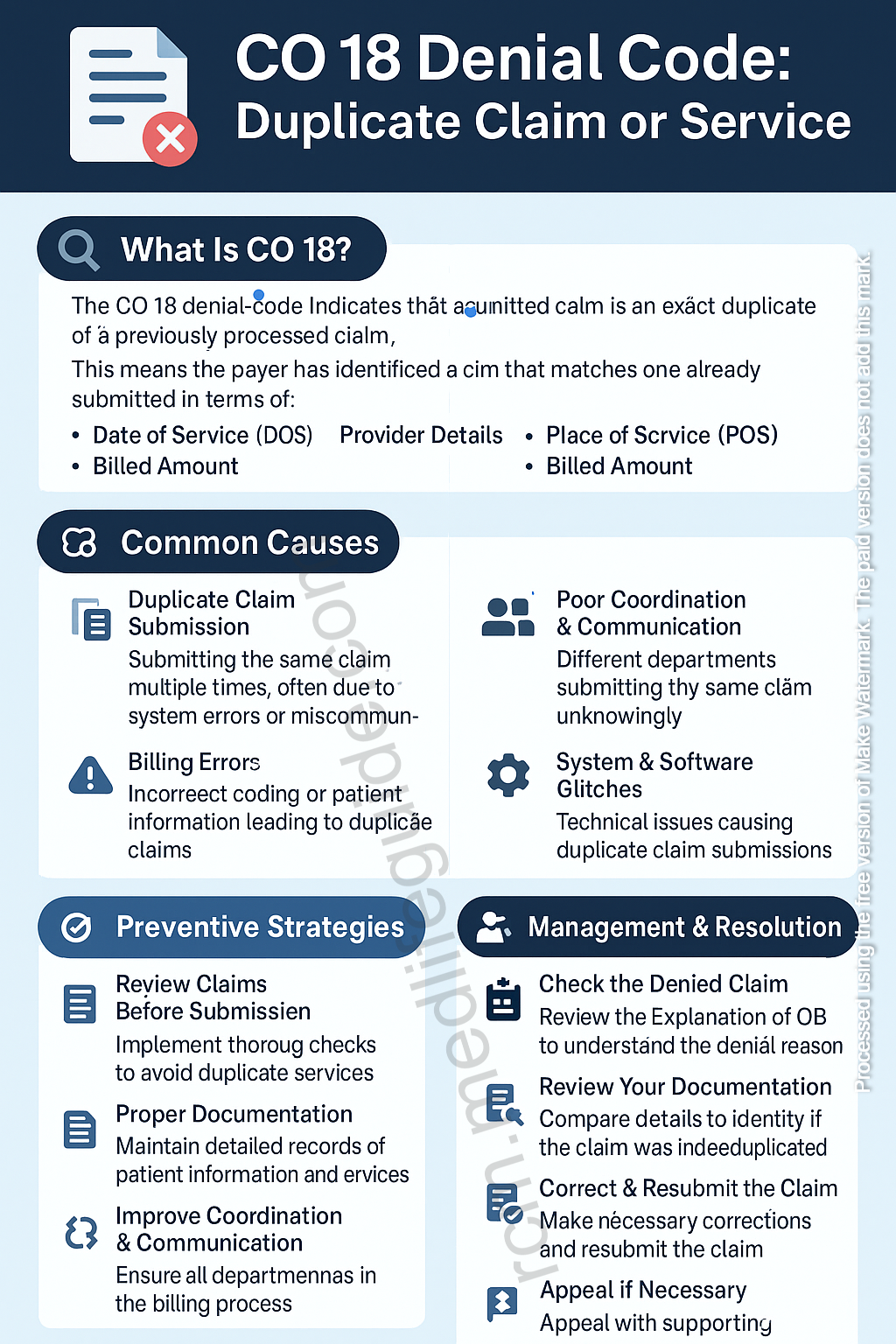

Denial Code (CO-18)

CO-18

Denial Code 18 signifies that the insurance payer has rejected the claim because it appears to be a duplicate submission. This occurs when a provider submits the same claim multiple times, whether intentionally or unintentionally, before the original claim has been fully processed. Common Causes of Denial Code 18 Several factors contribute to Denial Code … Read more

What is a Subscriber

In medical billing, the term subscriber refers to the primary individual who holds a health insurance policy. The subscriber is responsible for maintaining the insurance plan and ensuring that premiums are paid. The subscriber can also extend coverage to dependents, such as spouses or children, depending on the policy’s terms. Roles and Responsibilities of a … Read more

Medicaid – Eligibility Criteria

Medicaid Eligibility Criteria

Eligibility Criteria: To be eligible for Medicaid, an individual must be a U.S. citizen or a permanent legal resident for at least five continuous years and also meet at least one of the following Medicaid eligibility criteria: Federal Poverty Level Guidelines: Claim Submission:

Medicare Eligibility Criteria

Medicare Eligibility Criteria

1. Age-Based Eligibility 2. Work History or Spousal Coverage 3. Early Enrollment Options 4. Medicare Parts & Enrollment Essentials Part Overview Eligibility / Timing Part A Hospital Insurance Free with 40 credits; otherwise paid Part B Medical (Doctors, Outpatient) Enrollment typically at 65; late penalties if delayed Part C Medicare Advantage (via private insurers) Must … Read more

Sequestration

         Payment calculation without sequestration,          Billed Amount = $40.00          Allowed amount = $20.00          Paid amount = $16.00          Patient responsibility (Coinsurance) = $4.00          Payment calculation with sequestration,          The sequestration … Read more

The Birthday Rule & New Born Baby Coverage

newborn insurance under birthday rule

The birthday rule is a health insurance coordination policy used to determine which parent’s plan will be the primary payer when a newborn or child is covered under both parents’ health insurance. Despite how it sounds, the birthday rule doesn’t prioritize age—it goes by calendar date. In Simple Terms: This rule is widely followed by … Read more

Crossover Claim in Medical Billing: A Straightforward Guide for Billers and Patients

Crossover Claim

Let’s not overcomplicate this. If you’ve ever looked at a patient’s Medicare claim and wondered, “Who handles the secondary payment?”, you’re asking the right question. That’s exactly where crossover claims come into play. In this guide, we’ll unpack what a crossover claim really is, how it flows through the system, what makes it different from … Read more