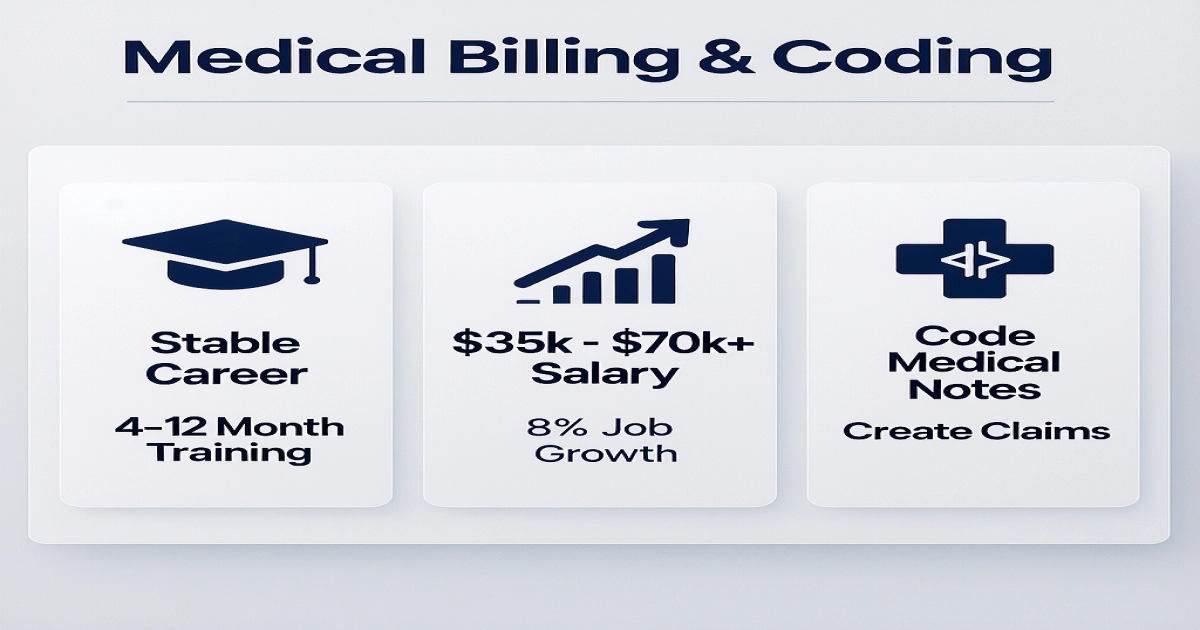
Medical billing and coding is a stable healthcare career that takes 4-12 months to learn. It involves two skills: coding doctor’s notes into universal codes and using those codes to create claims. The US healthcare system needs these professionals, with demand growing 7-8% through 2026. You can learn through a certificate, diploma, or associate degree. Accredited programs prepare you for certification exams. Salaries range from $35,000 to over $70,000, with certification increasing earnings by 10-15%.
Thinking about a career change in 2026? If you are looking for a stable healthcare profession that doesn’t require years of medical school or touching patients, medical billing and coding is a top contender. But the burning question for most career changers is: how long will it actually take before I can start earning?
The short answer: You can be job-ready in as little as 4 to 12 months.
While traditional degrees take years, the 2026 landscape for medical billing education is shifting toward accelerated, skills-based training. This guide explores exactly how fast you can learn, what it costs, and where to find the best accredited programs to launch your career this year.
1. Introduction to Medical Billing and Coding
Before diving into timelines, it is critical to understand what you are signing up for. While often grouped together, medical billing and medical coding are two distinct skills:
- Medical Coding: The “translation” side. You take a doctor’s notes (diagnoses, prescriptions, procedures) and translate them into universal alphanumeric codes (like ICD-10 or CPT). Accuracy here is vital for patient safety and data.
- Medical Billing: The “financial” side. You use those codes to create claims, submit them to insurance companies, and follow up to ensure the healthcare provider gets paid.
Why It Matters in 2026
The US healthcare system relies on these professionals to keep the revenue cycle moving. With an aging population and more complex insurance regulations, the demand for skilled billers is projected to remain strong.
Job Outlook: According to recent data, employment for medical records specialists is projected to grow ~7-8% through 2026 and beyond, faster than the average for all occupations.
2. How Fast Can You Learn Medical Billing?
In 2026, you generally have three “speed tracks” for learning medical billing. Your choice depends on your current schedule and career goals.
The “Fast-Track” Certificate (4 – 9 Months)
- Best for: Career changers who need to work now.
- Format: Intensive online bootcamps or self-paced certificate programs.
- What you learn: The essentials of reimbursement, CPT/ICD-10 coding basics, and HIPAA compliance.
- 2026 Reality Check: Some “4-month” programs are very intense. If you are working full-time while studying, realistically expect this to take 6–8 months.
The Diploma Program (10 – 15 Months)
- Best for: Students who want a comprehensive education without the fluff of a full degree.
- Format: Community colleges or vocational schools (online or hybrid).
- Benefits: often includes an “externship” (practicum) which gives you real-world experience—a huge plus when applying for jobs.
The Associate Degree (2 Years)
- Best for: Those aiming for management roles later on.
- Format: Traditional college curriculum.
- Benefits: Includes general education credits (English, Math) and goes deeper into Health Information Management (HIM).
3. Top Medical Coding and Billing Classes for 2026
When choosing a class, ensure it prepares you for the major certification exams: the CPC (Certified Professional Coder) or CPB (Certified Professional Biller).
Accredited Online Programs
- Purdue Global: Offers a Medical Billing and Coding Certificate that can be completed in under a year. It is fully online and prepares you for multiple certification exams.
- Southern New Hampshire University (SNHU): Known for its flexible online degrees, SNHU offers coding classes that can roll into a larger Health Information Management degree if you decide to continue studying.
- Penn Foster: A popular self-paced option. It is often more affordable than university programs and allows you to move as fast as you can master the material.
- Ultimate Medical Academy (UMA): Specializes in healthcare. They offer career services support to help you find a job after graduation, which is a significant value-add.
Are “Free” Online Programs Legit?
You may see searches for “free online medical billing and coding certification programs.” Be careful.
- The Reality: Legitimate certification is not free. The exams (AAP or AHIMA) cost money (approx. $300–$500).
- The Good News: There are free introductory courses (like AMCI’s i2MC introduction) that let you “try before you buy” to see if you actually like coding. Use these to test the waters, but expect to pay for a full professional training program.
4. Understanding Medical Coding and Billing Salary
Is the investment of time worth it? In 2026, salaries vary heavily by certification status and location.
Average Salary Ranges (2025/2026 Data)
- Entry-Level (0-1 year exp): $35,000 – $42,000 annually (~$17–$20/hour).
- Mid-Level (Certified): $50,000 – $62,000 annually.
- Top Earners/Specialists: $70,000+ annually.
The “Certification” Bump
Getting certified pays off literally. Certified coders earn significantly more than non-certified ones.
- AAPC Certified (CPC): often earn ~10-15% more than their non-certified peers.
- Job Market Note: Many employers in 2026 will not hire you without a certification, even if you have finished a course. Budget for the exam!
Regional Variations
- Highest Paying Areas: California, New York, New Jersey, and D.C. (often adjusted for cost of living).
- Remote Work: Remote roles are highly competitive in 2026. Entry-level remote jobs often pay slightly less than in-office roles due to the high volume of applicants.
5. Choosing the Right Medical Billing School
Not all schools are created equal. If you are going to spend 6+ months studying, make sure it counts.
Criteria for Selection
- Accreditation: Look for accreditation from agencies like CAHIIM or approval by the AAPC. This ensures the education meets industry standards.
- Exam Vouchers: Does the tuition include the cost of the certification exam? (This can save you ~$400).
- Financial Aid: Accredited schools (like community colleges and universities) are often eligible for federal financial aid (FAFSA), Pell Grants, and student loans. “Bootcamps” often are not.
Financial Aid & Resources
- FAFSA: Fill this out if applying to a college or university program.
- WIOA Grants: Check your state’s Workforce Innovation and Opportunity Act grants; they sometimes pay for retraining in high-demand fields like healthcare.
- Employer Sponsorship: If you already work in a hospital (e.g., at the front desk), ask if they offer tuition reimbursement for billing courses.