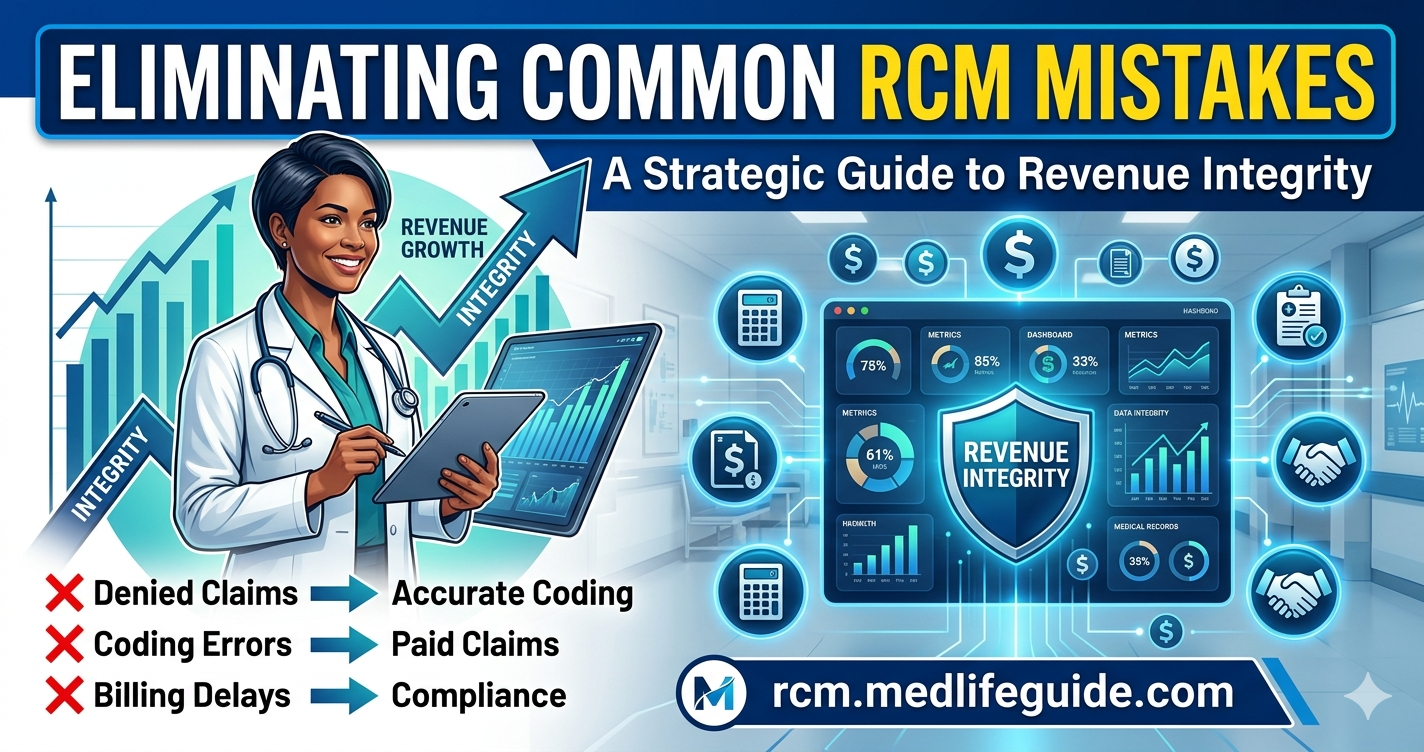
Revenue Cycle Management (RCM) is the financial heartbeat of a medical practice. When errors occur, they don’t just delay payments; they erode the practice’s bottom line through administrative waste and compliance risks. Most RCM failures stem from fragmented workflows or outdated manual processes that fail to catch inaccuracies before they reach the payer.
High-Impact RCM Coding Inaccuracies and Documentation Gaps
Coding errors—specifically upcoding, unbundling, or failing to use the most specific ICD-10/CPT codes—remain the primary drivers of medical billing mistakes. These often occur because the clinical documentation lacks the “specificity” required for high-complexity encounters.
- The Solution: Implement regular RCM training for new staff focused on E/M (Evaluation and Management) coding guidelines.
- Practical Example: A small cardiology practice consistently receives denials for “medical necessity” on stress tests. By auditing their notes, they find doctors aren’t documenting the patient’s specific symptoms (like stable angina) that justify the test. Improving this documentation at the point of care eliminates the denial trend entirely.
Resolving Front-End Patient Billing Errors
Approximately 30-40% of denials originate at the registration desk. Inaccurate insurance verification, expired policies, and misspelled patient names create a domino effect of claims processing mistakes.
- Best RCM Strategies for Small Practices: Shift eligibility verification to “T-minus 48 hours” before the appointment.
- Practical Example: Instead of checking insurance at the window, a clinic uses automated RCM solutions for compliance to batch-verify the next day’s schedule. This identifies a “COB” (Coordination of Benefits) issue for a high-cost surgery patient before they arrive, allowing staff to resolve it and secure a clean claim submission.
Best Methods to Reduce RCM Denials and Rejections
Many practices treat denials as a “cost of doing business” rather than a fixable data point. The best way to audit RCM processes is to categorize denials into “avoidable” versus “unavoidable.”
- Tools for Error Prevention: Utilize best RCM software with built-in “claim scrubbers” that mirror payer-specific rules.
- Practical Example: A multispecialty group notices a spike in denials for “duplicate claims.” An audit reveals their billing software is re-submitting claims every 14 days if no response is received, leading to automatic rejections. Adjusting the re-submission logic to 30 days and using EDI (Electronic Data Interchange) tracking stops the cycle of duplicates.
Advanced RCM Workflow Optimization
| Mistake Category | Root Cause | Best Practice for Prevention |
| Credentialing Lapses | Expired provider enrollments | Use automated alerts 90 days prior to expiration. |
| Payer Rule Ignorance | Outdated contract knowledge | Quarterly reviews of payer bulletins. |
| Patient Collections | Lack of upfront cost transparency | Provide “Good Faith Estimates” and collect at TOS (Time of Service). |
Best RCM Tips for Revenue Optimization
To achieve a high-performing revenue cycle, the focus must shift from “fixing errors” to “preventing them at the source.”
- Deploy Best RCM Training for New Staff: Focus on the “why” behind the data entry. If a registrar understands how a missing digit in a policy ID causes a 30-day payment delay, accuracy improves.
- Leverage Best RCM Consultants for Error Correction: If your Clean Claim Rate (CCR) is below 95%, external experts can provide an unbiased gap analysis of your billing process inefficiencies.
- Audit Regularly: Perform internal audits on a random 10% sample of monthly claims. This proactive approach identifies RCM workflow errors before they become systemic.
Practical Example: A practice struggling with cash flow hires a consultant who discovers that 15% of their revenue is tied up in “Timely Filing” denials. The fix wasn’t more staff, but a workflow change where the “Unbilled Charges” report is cleared every Friday by noon, ensuring no claim sits longer than 5 days.
Thank You for Visiting Our Website https://rcm.medlifeguide.com/. We Value Your Feedback!