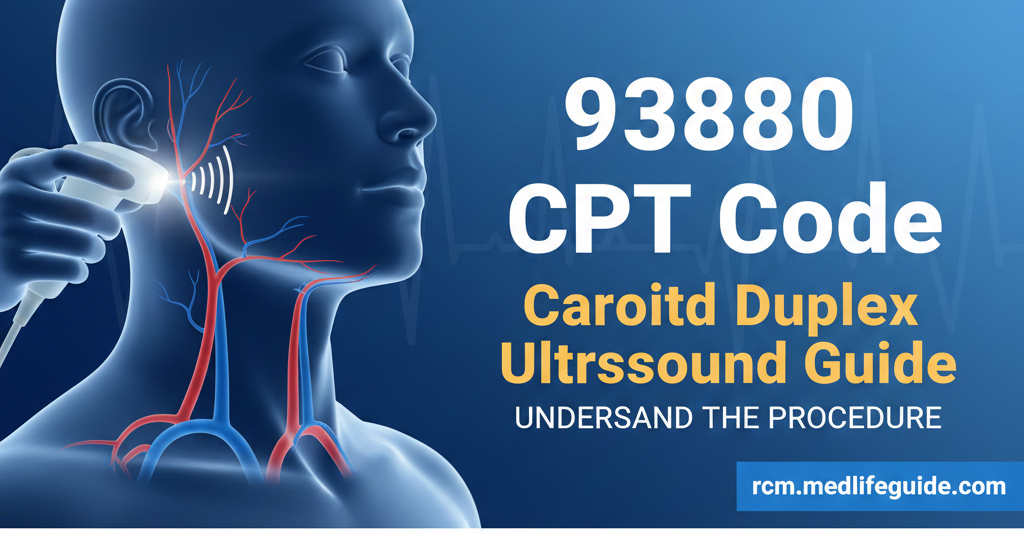
The 93880 CPT code is a diagnostic medical billing code used to report a complete bilateral duplex ultrasound study of the extracranial arteries. In clinical practice, this procedure is most commonly known as a carotid duplex ultrasound. It evaluates blood flow and structural integrity of the carotid and vertebral arteries located in the neck.
This test plays a central role in identifying vascular conditions that increase the risk of ischemic stroke, transient ischemic attack (TIA), and other cerebrovascular disorders. From both a clinical and billing perspective, correct use of the 93880 CPT code is essential for accurate diagnosis, appropriate reimbursement, and compliance with payer guidelines.
What Does CPT Code 93880 Represent?
CPT Code Definition
CPT 93880 refers to:
Duplex scan of extracranial arteries; complete bilateral study
This includes:
- B-mode (grayscale) imaging
- Spectral Doppler analysis
- Color flow Doppler
- Evaluation of both sides of the neck
Anatomical Areas Evaluated
A complete bilateral extracranial study typically examines:
- Common carotid arteries (CCA)
- Internal carotid arteries (ICA)
- External carotid arteries (ECA)
- Vertebral arteries
- Proximal subclavian arteries (when clinically indicated)
Clinical Purpose of the 93880 CPT Code
Why This Test Is Ordered
The 93880 CPT code is used when physicians need detailed information about blood flow and arterial narrowing outside the skull that may affect cerebral circulation.
Common clinical indications include:
- Suspected or known carotid artery stenosis
- History of stroke or TIA
- Presence of carotid bruit on physical exam
- Follow-up after carotid endarterectomy or stenting
- Evaluation of atherosclerotic disease
- Preoperative risk assessment for major surgery
How a Carotid Duplex Ultrasound Works
Step-by-Step Overview
- A transducer is placed on the neck.
- High-frequency sound waves create real-time images.
- Doppler technology measures blood flow velocity.
- Both left and right extracranial arteries are examined.
- Data is analyzed for plaque, narrowing, or flow abnormalities.
The procedure is non-invasive, radiation-free, and usually completed within 30–45 minutes.
CPT 93880 vs Related CPT Codes
Comparison With 93882
| CPT Code | Description |
|---|---|
| 93880 | Complete bilateral extracranial duplex study |
| 93882 | Unilateral or limited extracranial duplex study |
The 93880 CPT code should only be reported when both sides are fully evaluated. If only one side is examined or the study is limited, 93882 is more appropriate.
Medical Conditions Commonly Diagnosed Using 93880
Vascular and Neurologic Conditions
- Carotid artery stenosis
- Atherosclerotic plaque formation
- Arterial occlusion
- Vertebral artery insufficiency
- Subclavian steal syndrome
- Post-surgical restenosis
These findings directly influence treatment decisions, including medical management, surgical intervention, or further imaging.
Billing and Coding Guidelines for 93880 CPT Code
Key Billing Requirements
- Documentation must confirm bilateral complete study
- Doppler velocity measurements must be included
- Medical necessity must be clearly stated
- Ordering provider and interpreting physician must be documented
Common Billing Errors
- Reporting 93880 for unilateral exams
- Missing clinical indication
- Inadequate image or Doppler documentation
- Duplicate billing with other vascular ultrasound codes
Incorrect use can lead to claim denials or audits.
Reimbursement Considerations
Reimbursement for CPT 93880 varies by:
- Payer (Medicare, Medicaid, commercial)
- Place of service
- Geographic region
Medicare generally covers the test when ordered for approved indications such as stroke symptoms or carotid bruit, provided documentation supports medical necessity.
Unique Clinical Takeaways
1. Patient Experience Factors Affect Diagnostic Accuracy
Patient positioning, neck anatomy, and ability to remain still significantly affect image quality. Patients with limited neck mobility, obesity, or prior neck surgery may require modified scanning techniques. Poor acoustic windows can lead to underestimation or overestimation of stenosis severity.
2. Importance in Differential Diagnosis of Neurologic Symptoms
Not all dizziness, syncope, or neurologic deficits are due to carotid disease. A normal 93880 study can redirect clinicians toward cardiac, intracranial, or metabolic causes. This makes the test valuable not only for detection but also for exclusion of extracranial vascular pathology.
3. Risk Stratification Beyond Percent Stenosis
Clinical decision-making should not rely solely on percentage of narrowing. Plaque morphology, flow turbulence, and progression over time provide additional risk information. Patients with moderate stenosis but unstable plaque characteristics may carry higher stroke risk than those with stable high-grade stenosis.
Role of 93880 in Stroke Prevention
Early detection of carotid artery disease allows:
- Optimization of antiplatelet therapy
- Aggressive lipid management
- Blood pressure control
- Timely referral for vascular surgery
Population studies consistently show that appropriate carotid screening in high-risk individuals reduces stroke-related morbidity.
Who Performs and Interprets the Study
- Registered Vascular Technologists (RVT)
- Sonographers with vascular certification
- Interpretation by:
- Vascular surgeons
- Radiologists
- Cardiologists
- Neurologists (with vascular training)
Proper credentialing is required for reimbursement and compliance.
Limitations of CPT 93880
- Does not assess intracranial arteries
- Operator-dependent accuracy
- Calcified plaque can obscure flow signals
- Cannot directly visualize embolic events
In complex cases, additional imaging such as CTA or MRA may be required.
Documentation Checklist for Providers
- Clear indication for study
- Bilateral arterial evaluation
- Velocity measurements
- Plaque description
- Impression and clinical correlation
Complete documentation supports both patient care and billing integrity.